
Every newcomer to Bangkok asks the same question within their first month, and almost all of them ask it in a form that guarantees a disappointing answer. The question is: how do I make friends here?
I have been asked it across dinner tables in Thonglor, in the queue at a coffee shop in Ari, by members who have just landed and by people who have been here three years and are quietly embarrassed to still be asking. And the answer I have learned to give is not a list of places. It is a correction to the question.
You are not missing friends. You almost certainly have several already: the colleague you like, the neighbour who is easy to talk to, the person from the gym whose name you now know. What you are missing is a circle: a group with its own gravity, one that assembles without you having to assemble it, that has in-jokes and a default table and a WhatsApp thread which occasionally produces plans you did not initiate. Friends are made one at a time. A circle is a structure, and structures have to be designed.
That distinction is the whole of this essay, because it is the difference between a social life that runs on your energy and one that runs on its own.
The Difference Between Friends and a Circle
Consider what actually happens when you have friends but no circle. Every plan requires an act of will. You choose the person, you propose the evening, you negotiate the date, you pick the venue, you send the reminder. Each meeting is a project you personally manage. Nothing compounds, because the people never meet one another, which means the total maintenance cost of your social life rises linearly with the number of people in it, and your energy does not.
Then one Tuesday you are tired, and you do not send the message. Nobody notices, because nobody else in that arrangement has a reason to. Two months later you are lonely in a city where you know forty people.
A circle behaves differently, because it is a network rather than a set of spokes. When the people in it know each other, the plans no longer depend on any single person’s initiative. Somebody else books the table. The group survives your bad month. This is also why circles feel qualitatively different to belong to: what you experience as warmth is largely the experience of being remembered by people whose remembering you did not have to organise.
Robin Dunbar’s research on the layered structure of human social networks gives this a useful shape. Our relationships arrange themselves in roughly concentric layers (an intimate core of a handful of people, a close layer of around fifteen, a wider layer of fifty, and a broad circle of about a hundred and fifty acquaintances), each requiring a different quantity of contact to hold. Newcomers to a city almost always make the same strategic error: they try to build the innermost layer first, hunting for the two or three people who will become genuine confidants, and they treat every promising encounter as a candidate for that role.
But layers are built from the outside in. The close friend emerges from the fifty, and the fifty come from showing up somewhere often enough to be a familiar face. You cannot skip to intimacy, and the attempt is exhausting for everybody involved. What you can do is deliberately build the outer layer (the fifty people whose faces you know and who know yours), and then let the inner layers precipitate out of it. That is a far more achievable brief than “find a best friend in a city of eleven million”.
What Bangkok Does to Repetition
Every city imposes its own physics on this process, and Bangkok’s are unusually specific.
Jeffrey Hall’s research at the University of Kansas is the most useful finding I know for anyone starting a social life from zero. Hall’s work indicates that friendship is essentially a function of accumulated hours in shared company: roughly fifty hours to move from acquaintance to casual friend, around ninety to become a real friend, and something in the region of two hundred for close friendship. Those hours also have to be the right kind (leisure time, not obligation), which is why colleagues you see forty hours a week can remain strangers for years.
Two hundred hours is not intimidating when you break it down. It is two hours a week for two years, or an evening a week with a group who meet reliably. What makes it hard is not the total. It is the requirement for repetition, and repetition is precisely what Bangkok’s geography attacks.
The city is enormous and it moves slowly. A friendship that requires crossing town in evening traffic is a friendship on probation, and the sentence is usually commuted to nothing. I have watched this kill more promising connections than any personality clash: two people who genuinely liked each other, separated by an hour of Sukhumvit at half past six, agreeing sincerely to do this again and never doing it. The propinquity effect (the well-documented tendency of relationships to form between people who share physical space and routine) is not a soft observation about convenience. In a city like this one it is the single strongest predictor of who will still be in your life next year.
So the first Bangkok-specific rule is unglamorous and non-negotiable: build your circle along a line, not across a map. Choose one or two neighbourhoods you can reach without negotiating with the traffic (your own, and one within a comfortable stretch of the BTS or MRT), and put the great majority of your recurring commitments there. This feels like a compromise on ambition. It is the opposite. A run around Lumphini Park you will actually do fifty times beats a superb supper club on the far side of the river you will attend twice.
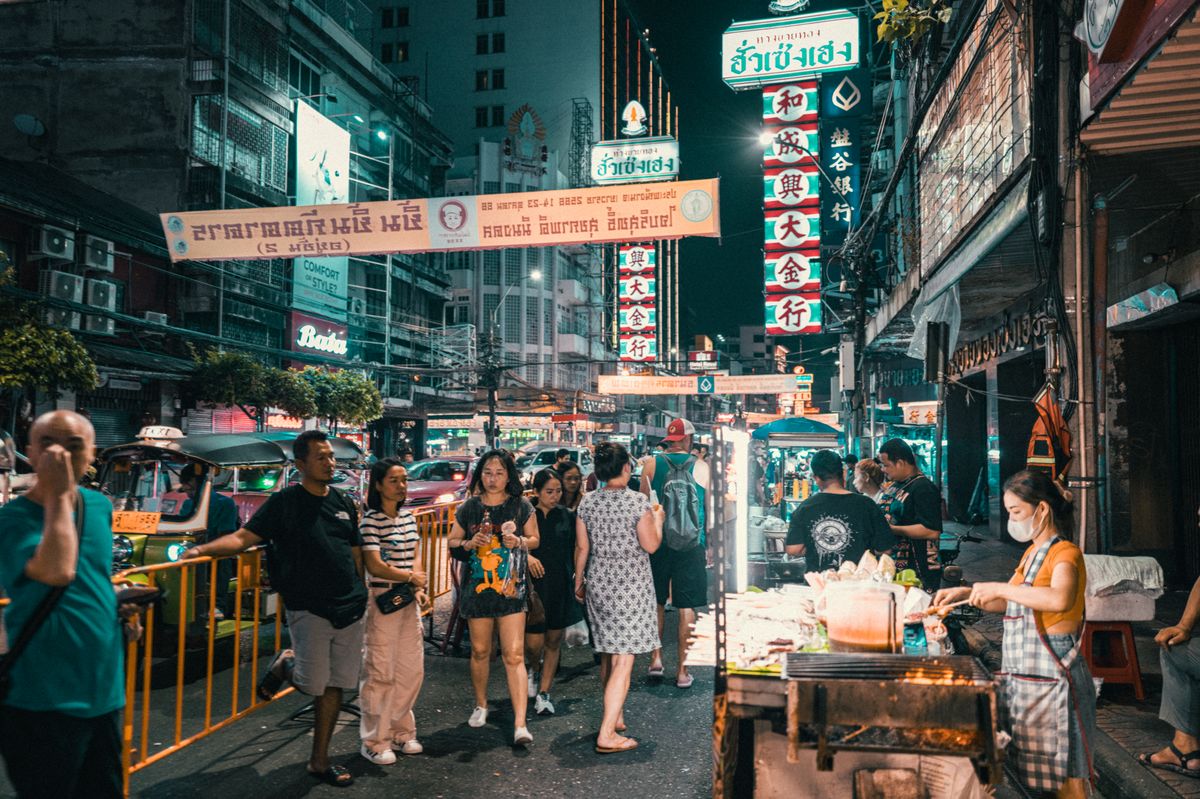
Bangkok’s second physical trait is more generous. This is a city with an extraordinary density of places designed for lingering: markets, riverside walks, the long green loop of Benjakitti Park, the galleries around the Bangkok Art and Culture Centre, and a coffee-shop culture that has quietly made the whole city an office. When you have chosen your geography, the raw material for repetition is unusually abundant. The constraint is never what to do. It is who you will do it with, again, next week.

The Ninety Days You Do Not Get Twice
There is a window that opens the day you arrive, and it closes quietly.
For roughly your first three months you are new, and newness is a social licence. You can ask direct questions without seeming strange. You can accept an invitation from someone you barely know. You can turn up alone to a class or a run club and say, honestly, that you have just moved and do not know anybody, a sentence which, in my experience, produces more genuine warmth in Bangkok than almost any other. Nobody expects you to have a settled life yet, and everybody has some memory of arriving.
Then the licence expires. Not because people become unkind, but because you become furniture. After six months, showing up somewhere new and announcing that you know nobody carries a faint stigma that has nothing to do with reality. Worse, by then you have a routine, and routines fill with the things you did in month four out of convenience rather than the things you would have chosen. Most people’s social lives are not decided; they calcify.
The practical implication is that the first ninety days should be run deliberately and slightly uncomfortably fast. Say yes to nearly everything, including things you suspect you will not enjoy. You are not sampling activities, you are sampling rooms and the people in them. Attend more than you can sustain, knowing that the point of a wide first pass is to find the three or four settings worth returning to for two years.
And then, importantly, narrow. The commonest failure I see in Bangkok is not the person who does too little. It is the person who does far too much, in twelve different scenes, and accumulates two hundred acquaintances and no circle, because they never gave any single room enough repetitions to convert. Breadth is for month one. Depth is for everything after.
Choose Rooms That Repeat
If you take one operational principle from this essay, make it this: commit to formats, not to events.
An event is a one-off. It produces an evening, a few pleasant conversations and, usually, nothing. A format is anything that recurs with the same faces: a Sunday run group, a weekly class, a monthly supper, a five-a-side game, a members’ community with a rhythm. Formats produce the accumulation Hall’s research describes, and they do it without anybody having to organise a thing. The mere-exposure effect quietly works in your favour: people you encounter repeatedly become people you like, largely because familiarity itself is pleasant.
I would go further and say that most newcomers should aim for a specific architecture in their first year. Three recurring commitments, roughly. One physical: sport, running, climbing, anything where the activity carries the conversation and nobody has to be charming to belong. One interested: a class, a language group, a craft, something where you are all visibly beginners at something. And one purely social: a supper club, a regular dinner, a community that exists for its own sake. Three is enough to produce the fifty-person layer within a year, and few enough to survive a demanding job.
Then two more habits, which are where most circles are actually made. The first is the second invitation. Almost everyone in Bangkok is warm on first meeting; the city is genuinely sociable and the small talk is excellent. What separates the people who build circles from the people who collect contacts is the willingness to make the second, specific, unglamorous invitation: the “I’m going to that thing on Thursday, come” that follows a good first conversation by less than a week. A vague “we should hang out” is a pleasantry. A time and a place is an invitation.
The second habit is to become the person who introduces. Bring two friends from separate parts of your life to the same table. This feels counter-intuitive (you are giving away your friends, and there is a small, real anxiety that they will like each other more than they like you), but it is the mechanism by which a set of individual friendships turns into a network with its own life. Once your friends know each other, the maintenance burden stops being yours alone. That is the moment a circle actually exists.
If you want a fuller local map of where those formats live in this city, I have written a practical companion to this piece on how to meet new people in Bangkok, and a more candid one on the specific traps expats fall into in making friends in Bangkok as an expat.
Building for Churn
There is one more design requirement here that people discover too late, and it deserves to be stated plainly: Bangkok is a city people leave.
Expat social circles are subject to constant attrition: contracts end, companies relocate, someone’s partner takes a job in Singapore. If your circle consists of six close friends who all know each other and three of them depart within a year, you do not lose half a circle. You often lose the whole thing, because the structure that held the rest together goes with them.
Two things protect against this. The first is overlap: build across at least two distinct scenes, so that no single departure takes out a whole social ecosystem. The second, and more important, is to seed your circle with people who are not going anywhere. Long-term residents and Thai friends are not merely a richer way to live here (though they are that, and building a life in Bangkok exclusively among other foreigners is a strange and diminished way to spend your years in one of the world’s great cities). They are also the structural anchor that lets a circle survive its own turnover. The friends who were here before you arrived are usually the ones still here when everyone else has gone.
None of this is only about pleasantness, incidentally. Julianne Holt-Lunstad’s meta-analyses on social connection and mortality found that strong social relationships are associated with a substantially greater likelihood of survival, with effects comparable in magnitude to well-established risks such as smoking and exceeding those of obesity and physical inactivity. The circle you build in your first year in a new city is not a lifestyle accessory. It is closer to infrastructure.
What We Learned Building This in Bangkok
I started SPARK because I had lived the specific version of this problem that technology had made worse rather than better. I had the contacts, the matches and the followers, and I noticed that almost none of it reliably became a Tuesday evening with people I cared about. The introductions were solved. The meeting was not.
Everything we have built in Bangkok since follows from taking that gap seriously. Profiles on SPARK are real and anonymous accounts are not accepted, because the reason people hesitate to walk into a room of strangers is rarely shyness. It is uncertainty about who will be in it (we wrote more on that in why identity verification matters). At our hosted evenings, hosts make the introductions, and we would much rather people come back than come once, for exactly the reasons above: depth needs airtime, and repetition needs a reason to return. And because plans in this city die of logistics more often than of disinterest, the app is built around agreeing a plan to meet in a public place, so that a good intention becomes a time and a place.
The number I watch most closely is not downloads or messages sent. It is completed real-world meetings: evenings that actually happened, with people who actually turned up. It is a deliberately unforgiving metric, and it is the only one that describes whether a connection company is doing its job.
The Circle Is a Place, Not a List
Here is the thing nobody tells you when you land: the social life you will have in Bangkok in three years is being decided, quietly, by what you do repeatedly in your first six months. Not by the number of people you meet, which will be enormous and mostly irrelevant, but by the small number of rooms you choose to return to until the faces in them are familiar.
That is genuinely all a circle is. Not a list of names in a phone, but a handful of places where you are expected: a Sunday run that starts whether you come or not, a table that gets booked because it is the second Thursday, a group of people who have accumulated enough hours together that presence no longer requires an occasion.
You cannot make that in a month, and you cannot make it by trying harder at individual friendships. You make it by choosing a geography you can sustain, a few formats that repeat, and the discipline to keep showing up long after the novelty has gone. The city will meet you more than halfway. Bangkok is not a cold place, and it has never been short of tables. It is only short of people who return to the same one.
Pick your table. Then go back next week.
Looking to meet interesting people in real life? Get the SPARK app or come to one of our evenings.
FAQs
How long does it realistically take to build a social circle in Bangkok? Expect six to twelve months for something that feels like a genuine circle, assuming you commit to two or three recurring formats rather than attending occasional one-off events. Jeffrey Hall’s research suggests roughly fifty hours of shared leisure time to reach casual friendship and around two hundred for a close one, which at one evening a week is a matter of months, not years. What extends the timeline is inconsistency, not a lack of opportunity.
Should I focus on meeting other expats or on making Thai friends? Both, deliberately. Newly arrived expats are the fastest route to early momentum because they are in the same position as you and are actively looking. Long-term residents and Thai friends are what makes a circle durable, since they are still here when contracts end and people move on. A circle built exclusively from other newcomers tends to dissolve within two years.
What if I work long hours and cannot commit to something every week? Then commit to one thing, and protect it absolutely. A single fortnightly format you never miss will build a circle faster than four weekly commitments you attend erratically, because familiarity depends on reliability rather than volume. Choose something close to home or your office so that traffic never becomes the reason you skip it, and consider joining a community like SPARK, where the organising is done for you and hosts make the introductions at our evenings.
Founder’s Note
I moved cities enough times before starting SPARK to know the particular quiet of a Sunday evening in a place where nobody is expecting you. What surprised me was how little the difficulty had to do with meeting people. Bangkok gave me introductions by the hundred. What it did not give me (what no city gives you automatically) was the structure that turns those introductions into a life.
That is the problem we are trying to solve, and it is a more architectural problem than it first appears: not how to help people match, but how to help them return. Rooms that repeat, faces that become familiar, evenings that happen because it is the second Thursday and that is simply what we do. If you have just arrived here, be patient with the timeline and impatient with your own calendar. Choose your three rooms this month, and go back to them for a year. I would very much like one of them to be ours.
Sunny Khurana, Founder & CEO, SPARK
Keep Reading
More from the Journal



Looking to meet interesting people in real life?
SPARK helps you find people to do the things you enjoy. Get the free app, or come along to one of our hosted evenings in Auckland and Bangkok.
Or read us first — new essays on real-world connection, monthly.