
Singapore Is Full of People — Finding Yours Is the Work
Singapore is one of the easiest cities in Asia to stand next to interesting people. Residents and visitors from more than 180 nationalities are compressed into 730 square kilometres, the MRT delivers you anywhere in forty minutes, and on any given Tuesday there are more talks, runs, tastings and meetups than any one person could attend in a year.
And yet the most common thing I hear from members in Singapore is some version of the same sentence: I've been here two years and I still don't have people.
The challenge was never finding people. It's finding your people — and the difference between the two is not geography. It's structure.
So this piece is a map. Not a listicle of venues to tick off, but a guide to the scenes where connection in Singapore actually happens: the run clubs, the hawker tables, the climbing gyms, the neighbourhood villages, the after-work belts. If you want the mindset and the method — how to show up, what to say, how to turn a familiar face into a friend — I've written that separately in how to meet new people in Singapore. This is the companion piece. This is where.
One principle governs everything that follows, so let me state it plainly before we start walking the map.
Places don't make friends. Repetition does.
Recurring Communities Beat One-Off Events
Attending one networking event almost never changes your social life. Returning to the same community every week very often does. This isn't a motivational slogan; it's about as close to a law of human connection as social science offers us.
Psychologists call one part of it the mere-exposure effect: we grow to like people simply through repeated, low-stakes contact. Another part is the propinquity effect — the well-documented finding that friendships form disproportionately between people who cross paths regularly, which is why so many of your school friendships felt effortless. You didn't choose those people out of a catalogue. The timetable chose them for you, week after week, until familiarity did its quiet work.
Then there's the matter of hours. Jeffrey Hall's 2018 research at the University of Kansas estimated that a casual friendship takes somewhere around fifty hours of shared time, a real friendship closer to ninety, and a close one two hundred or more. Nobody accumulates two hundred hours at one-off events. You accumulate them by belonging somewhere that meets on Tuesdays.
So as you read the rest of this map, apply a single filter to every place on it: can I come back next week, and will the same people be there? A spectacular one-night event that scores poorly on that question is entertainment. A modest weekly gathering that scores well on it is infrastructure for a social life.
Everything that follows is chosen because it passes that test.
Founder and Professional Communities
Singapore's startup and professional ecosystem is dense in a way few cities can match, and — used correctly — it is one of the warmest doors into the city.
The trick is to distinguish between events designed for exchanging LinkedIn connections and communities designed for knowing people. Founder breakfasts that meet monthly with the same core group. Coworking spaces where you take a desk rather than a day pass, because the value of a coworking space is not the wifi — it's seeing the same forty faces every morning until several of them become people you actually know. Demo nights and small industry suppers where the room is thirty people, not three hundred. Peer circles for product people, designers, marketers, lawyers — nearly every profession in Singapore has one, usually organised through a scrappy WhatsApp group that matters more than any conference.
Geography helps you here. Singapore has a genuine after-work belt — the stretch running through Telok Ayer, Amoy Street, Duxton Hill and Tanjong Pagar — where professional Singapore decompresses between six and nine. The wine bars and standing-room izakayas along those streets host a constant rotation of small gatherings, and because the belt is compact, the same crowds re-encounter each other constantly. Choose one or two haunts and become a regular rather than a tourist of ten.
I've written a fuller guide to the best networking events in Singapore, but the summary is this: go smaller, go recurring, and go with the intention of finding collaborators and friends rather than contacts. The professionals I know with the richest networks in Singapore never once "networked". They joined things and kept showing up.
Fitness and Wellness Communities
If I could only recommend one category on this entire map, it would be this one. Shared physical effort is the fastest social lubricant I know that doesn't come in a glass.
Start with the run clubs, because Singapore's running scene has quietly become one of the great social institutions of the city. Groups gather at dawn and dusk along East Coast Park, around Marina Bay, through the Green Corridor and at the Botanic Gardens — some serious, many gloriously not, most finishing at a kopitiam or a coffee shop, which is where the actual community happens. The run is the pretext. The table afterwards is the point. Show up to the same club for six consecutive weeks and you will know people; this is as close to guaranteed as social advice gets.
Then the climbing gyms. Bouldering may be the single most conversation-friendly sport ever devised: you climb for thirty seconds and then stand around for five minutes discussing the problem with whoever is beside you. Strangers spontaneously coach each other. Singapore's bouldering gyms — and there are now many, spread from the CBD to the heartlands — are full of regulars who arrived alone and left with a crew. Nobody thinks it's odd that you came by yourself, because half the gym did.
Beyond those two anchors: padel has exploded across the city and is structurally sociable because you need four people, so clubs constantly match strangers into games. CrossFit boxes and group-training studios build fierce little tribes. Yoga studios reward the regular. Cycling groups roll out towards Mandai and the airport loop on weekend mornings and breakfast together afterwards. Dragon boating — a Singapore classic — is essentially a friendship machine with paddles.
Pick the one your body will let you love, and commit to a schedule rather than a drop-in. Shared goals make conversation effortless, and sweat is a remarkable equaliser: nobody's job title survives a hill sprint.
The Neighbourhood Village: Hawker Tables and Third Places
Here is the most underrated section of this map, and the most Singaporean: your own neighbourhood.
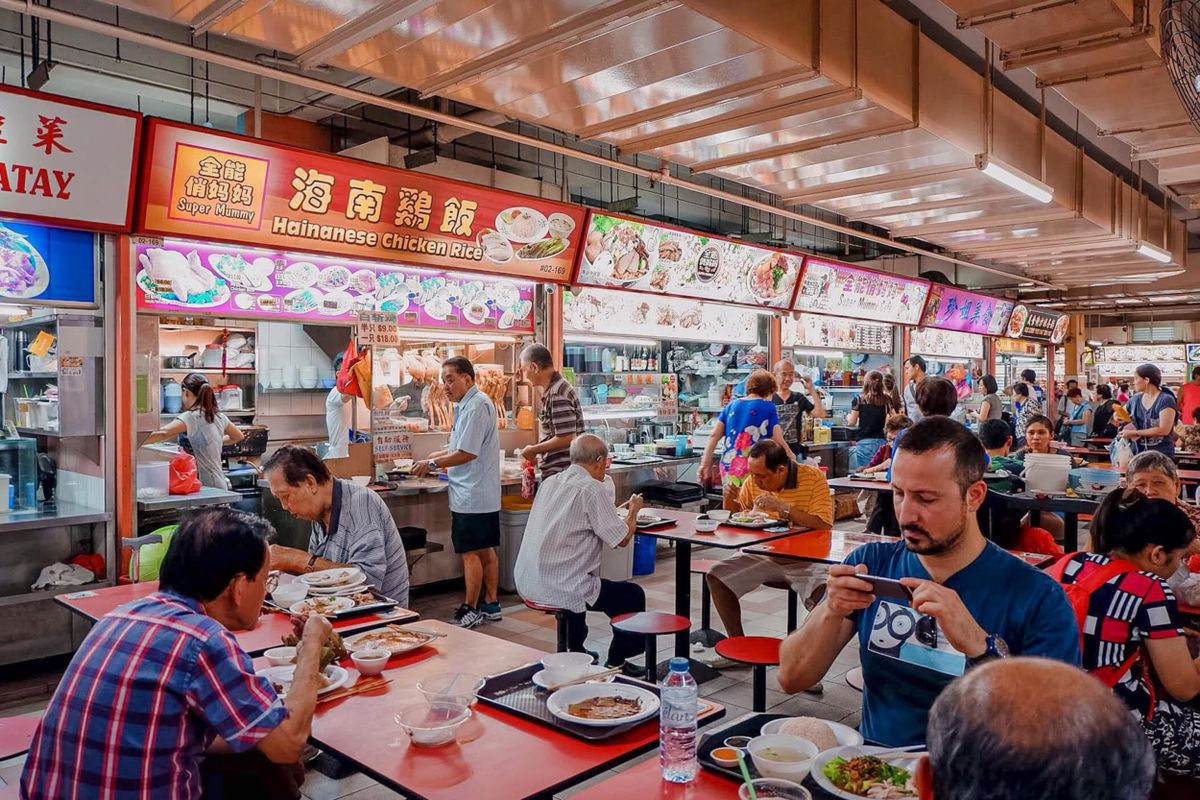
Singapore is often described as one city, but it lives as a collection of villages — Tiong Bahru, Joo Chiat and Katong, Everton Park, Holland Village, Serangoon Gardens, Bukit Timah, and dozens of HDB estates each with their own gravitational centre. That centre is almost always food. The hawker centre is Singapore's true town square: communal tables, shared benches, the choreography of chope-ing seats and the great democratic crush of everyone from students to CEOs queueing for the same char kway teow.
Hawker tables will not hand you friendships on the first visit. But they are where the village recognises itself. Eat at the same stalls weekly and the uncle starts your order when he sees you. The independent coffee shops layered through Tiong Bahru, Everton Park and Joo Chiat work the same way — become a genuine regular at one, the kind who sits in rather than takes away, and within a month you're greeting the baristas and nodding at the other regulars. Sociologists call these third places — the settings that are neither home nor work, where community forms as a by-product of simply being there. Robert Putnam's work on social capital showed what happens to societies when these places thin out; Singapore, blessedly, still has them in abundance.
Add the neighbourhood's other institutions: the wet market on Saturday mornings, the community centre with its absurdly affordable classes in everything from pottery to Mandarin, the park connector where the same dog-walkers pass at the same hour, the residents' interest groups. None of these is glamorous. All of them compound.
The deeper point is about radius. A friend who lives forty-five minutes away is a monthly friend; a friend from your neighbourhood is a Tuesday-night friend. When you shrink the radius of your social life, you raise its frequency — and frequency, as we've established, is the whole game.
Creative and Cultural Experiences
Not everyone bonds through burpees, and Singapore's creative scene offers a parallel map for people who connect best while making, learning or watching something.
Photography walks through Chinatown, Little India and Kampong Glam attract people who are curious by definition — and curiosity is the best raw material for conversation I know. Cooking classes and hawker-culture workshops put strangers shoulder to shoulder over a shared task, which beats face-to-face small talk every time; it's far easier to talk to someone while your hands are busy folding dumplings. Language exchanges fill cafés with people who are, by construction, there to talk to strangers. Pottery and craft studios, life-drawing sessions, book clubs at the independent bookshops, writing circles, improv classes — improv deserves special mention as possibly the fastest trust-builder on this whole map — all run weekly, all built around regulars.
The cultural calendar helps too: gigs at the small live-music rooms, gallery openings around Gillman Barracks and the museum belt, film clubs, theatre. A one-off exhibition visit is a lovely evening rather than a community, so apply the recurring filter here as everywhere — join the choir rather than attending the concert, join the sketching group rather than visiting the gallery once.
What I love about the creative map is who it selects for. These rooms gather people who have opted into learning and noticing — people who ask better questions and tell better stories. The conversations start three layers deeper than they do beside a conference lanyard table.
Volunteer and Give Back
One of the fastest ways I know to build real friendship is to work beside someone for a cause neither of you is paid to care about.
Volunteering compresses the trust-building timeline because it reveals character immediately. You learn more about a person in three hours of packing food parcels, cleaning a beach at East Coast, walking shelter dogs or befriending isolated seniors than in three months of pleasant brunches. Shared purpose does what small talk cannot: it gives you something real in common from the very first hour.
Singapore makes this unusually easy. National volunteer-matching platforms list thousands of recurring roles; charities, migrant-worker support groups, environmental initiatives and animal shelters all run weekly programmes that depend on regulars. And that word — regulars — is again the key. Choose a cause you genuinely care about, then choose a recurring commitment within it rather than one-off flag days. The Saturday-morning team that serves together every week becomes, within a couple of months, a group that celebrates birthdays together.
There is also something quietly corrective about it. So much of meeting people in a professional city carries a whiff of transaction — what does this person do, what might they be worth knowing? Volunteering strips that out entirely. Nobody is networking at the food bank. Which is precisely why the friendships formed there tend to hold.
Curated Experiences Beat Crowded Rooms
Somewhere along the way, we collectively confused more people with more connection. Singapore's events calendar is full of gatherings with three hundred attendees that produce, on average, zero lasting relationships per person.
The mathematics of a big room work against you: dozens of ninety-second conversations, business cards nobody follows up, and the strange loneliness of leaving a crowded event knowing nobody better than when you arrived. Contrast that with a curated dinner for eight, a rooftop gathering for a dozen, a hike with ten people and three unhurried hours of trail. Small formats give every conversation room to go somewhere. Quality beats quantity so reliably that I now treat headcount as an inverse predictor of an event's social value.
This is the design insight my whole company is built on, and it's why SPARK's experiences are deliberately small and built around a shared activity rather than a free-for-all mingle. We learned early — and I tell the longer version of that story in match is easy, meeting is hard — that the format of a gathering matters more than the guest list. Give strangers a table, a shared task and enough time, and connection stops being a matter of luck.
When you're choosing what to say yes to in Singapore, favour the small, the seated and the slow. The best rooms in this city hold twelve people, not twelve hundred.
Where SPARK Fits on This Map
Everything above is available to you today, without us. So let me be honest about where SPARK belongs on this map.
The hard part of every scene I've described is the same: walking in for the first time, alone, unverified, unsure whether the people in the room are your people. That cold-start problem is what we built SPARK to solve. We're not a dating app; we're building something we call social discovery — a verified community where curated, real-world experiences do the introducing, whether you're looking for friends, collaborators, mentors, activity partners or something romantic. Every member is verified, every gathering is designed rather than left to chance, and the whole point is to get you off your phone and into the city. Our members have now sat down together at 892 completed real-world meetings, across a network of more than 3,000 partner venues in Singapore and Bangkok — many of them exactly the kinds of places on this map.
Instead of endlessly collecting matches and contacts, members actually meet. Then — and this is the part I care about most — they keep meeting, because the experiences feed people into exactly the recurring communities this article has been describing. If you're starting from zero, making friends in Singapore pairs well with this map; and if you're weighing up how we think about trust and verification, our approach is set out at safety.
Looking to meet interesting people in real life? Download SPARK or join our verified community.
FAQs
What is the single best place to meet new people in Singapore? If forced to choose one, I'd say a weekly run club or a bouldering gym, because both combine easy conversation with built-in repetition. But the honest answer is: whichever recurring community you'll genuinely return to every week. Consistency beats venue selection every time.
Is it harder to meet people in Singapore as an expat? The first weeks can feel that way, because so much local social life runs through long-standing school and family networks. But Singapore's club, fitness and volunteer scenes are unusually open, and half the people in them are newcomers too. Join two recurring communities and give it six weeks; the city opens up remarkably quickly.
How long does it take to build real friendships this way? Research by Jeffrey Hall suggests casual friendship takes roughly fifty hours of shared time and close friendship two hundred or more, which is why one-off events rarely work. In practice, expect familiar faces within a month of weekly attendance and genuine friendships within three to six months. The timeline shortens dramatically when the hours are concentrated in small, recurring groups.
Founder's Note
Cities become extraordinary because of the people we meet inside them. Singapore gave me some of the most important relationships of my life, and not one of them arrived at a big event with a lanyard. Every single one came from somewhere I kept returning to.
So take the map, but remember the legend printed on it: places don't make friends, repetition does. Choose two or three scenes from this guide, put them in your calendar as standing appointments, and keep showing up long enough for familiarity to do its quiet work. Your social life will transform — not suddenly, but certainly.
I hope to see you at a table somewhere in this city.
— Sunny Khurana, Founder & CEO, SPARK
Keep Reading
More from the Journal


Looking to meet interesting people in real life?
SPARK is a members’ community for dating, friendship and professional connection — built around curated real-world experiences in Bangkok, Singapore and, from September, New Zealand.
Or read us first — new essays on real-world connection, monthly.