The View Is Not the Point
Every guide to the rooftop bars of Bangkok is secretly the same guide. It ranks the view. Sixty floors beats fifty. A glass edge beats a railing. A photograph of a cocktail against a sunset, repeated eight times, with adjectives.
I want to write a different guide, because I think the view is the least interesting thing about a Bangkok rooftop.
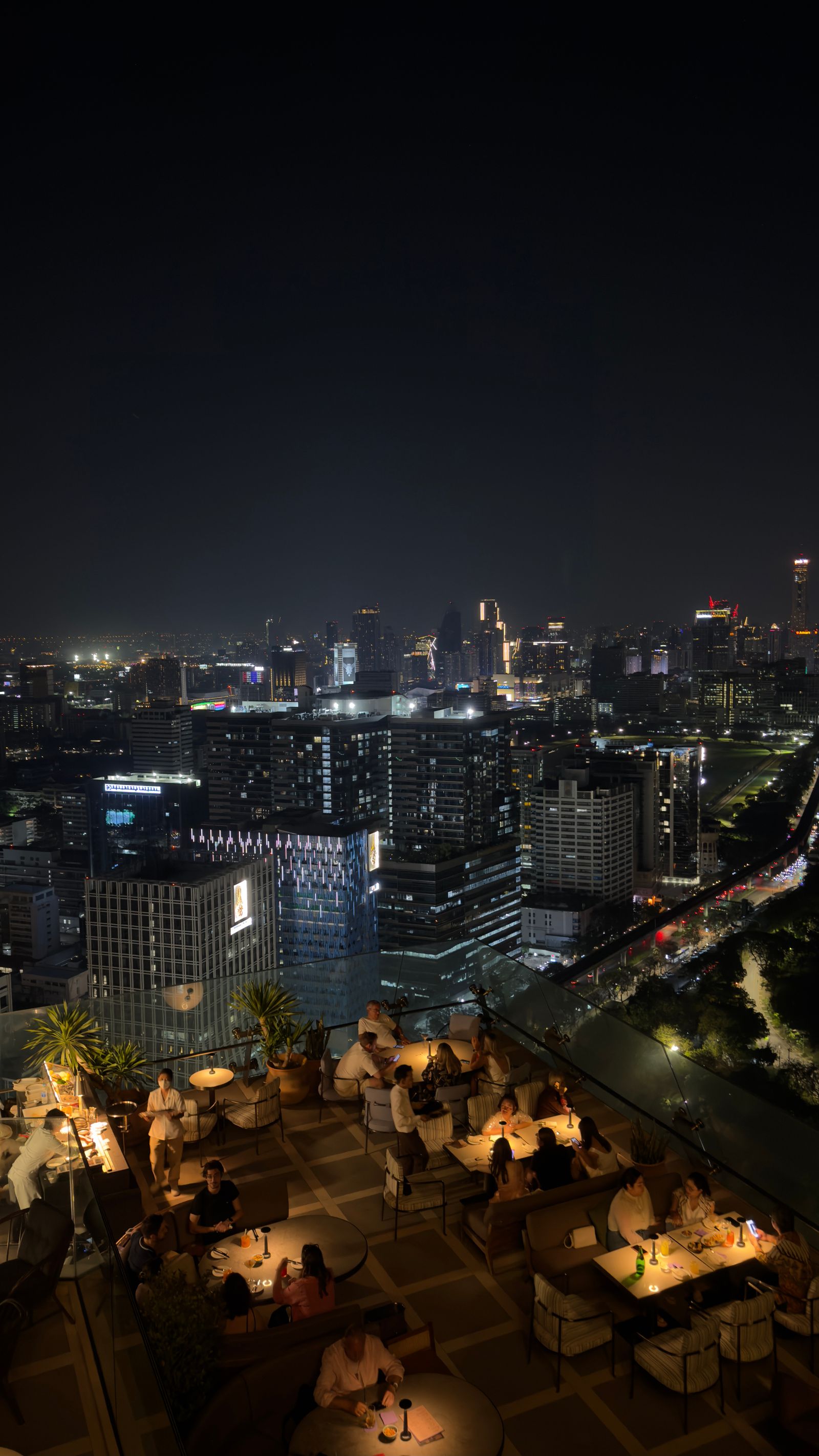
Bangkok has, by common consent, the best rooftop bar scene on earth. This is partly an accident of regulation — few major cities allow genuinely open-air bars at these heights — and partly an accident of geography: a flat river delta with no hills, so the city built its own. Stand on any of its famous rooftops at dusk and you can see the whole improbable sprawl at once, the Chao Phraya bending through it like poured metal.
But here is what I have noticed after years of living here, and after watching thousands of people try to build social lives in this city: most people do not go up those towers for the skyline. Not really. They go up hoping something will happen. A conversation. A spark. An evening that turns into a story. The view is the pretext; the people are the point.
And judged by that standard — not how far you can see, but how likely you are to actually meet someone — Bangkok’s rooftops are wildly unequal. Some of the most photographed bars in Asia are, socially speaking, among the loneliest rooms in the city. Some of the less solemn ones are quietly brilliant at introducing strangers.
So this is my honest map of the famous rooftops — Vertigo, Sky Bar, Octave, Above Eleven, Tichuca, CRU — judged not as viewpoints but as social rooms. Which ones are theatres, where you watch. Which ones are galleries, where you circulate. And which ones are actual parties, where the architecture itself is on your side.
What Makes a Rooftop Sociable
Before the bars themselves, it is worth being precise about what we are measuring, because sociability is not a vibe. It is a set of design decisions.
The first is standing culture. A rooftop where everyone is seated at reserved tables is a restaurant with weather. Tables are territories; once two people are installed at one, the social borders are drawn for the evening. A rooftop with generous standing room around a bar is a different organism entirely — people drift, orbits cross, and the walk to order a drink becomes a lap of the room.
The second is volume. There is a narrow band of music loud enough to give a place energy and forgive silences, but quiet enough that you can hear a stranger’s answer to a question. Below it, every word feels observed. Above it, you are reduced to smiling and pointing. The best social rooftops live inside that band, at least until late.
The third is circulation — whether the layout gives you a reason to move. Multiple levels, a walk to the view, a bar away from the tables. Movement creates encounters; psychologists have a name for the underlying effect, the propinquity effect, which is the well-documented finding that we befriend the people we repeatedly, casually cross paths with. A rooftop that keeps its guests in motion is running that mechanism all night.
And the fourth is the one everyone underestimates: a shared spectacle. This is the rooftop’s great structural advantage over the street-level bar. When the sun drops behind the towers at half past six and the whole terrace turns to face it, every person up there is briefly having the same experience at the same time. Shared attention is the oldest social lubricant there is — it is why strangers talk to each other at fireworks and football matches and nowhere else. The sunset is Bangkok’s nightly icebreaker, and it never needs a host. “Not a bad view” is a complete opening line, available to anyone, every single evening.
I have written elsewhere that the best dates and the best friendships begin with a third thing — something to look at, react to, and talk about that is not each other. It is the whole argument of my guide to date ideas in Bangkok, and it applies doubly here. A rooftop is a third thing you can stand on.
Keep those four tests in mind — standing room, volume, circulation, spectacle — and the famous names sort themselves with surprising speed.
The Icons: Breathtaking, and Socially Silent
Start with the two rooftops on every postcard, because they teach the lesson best.
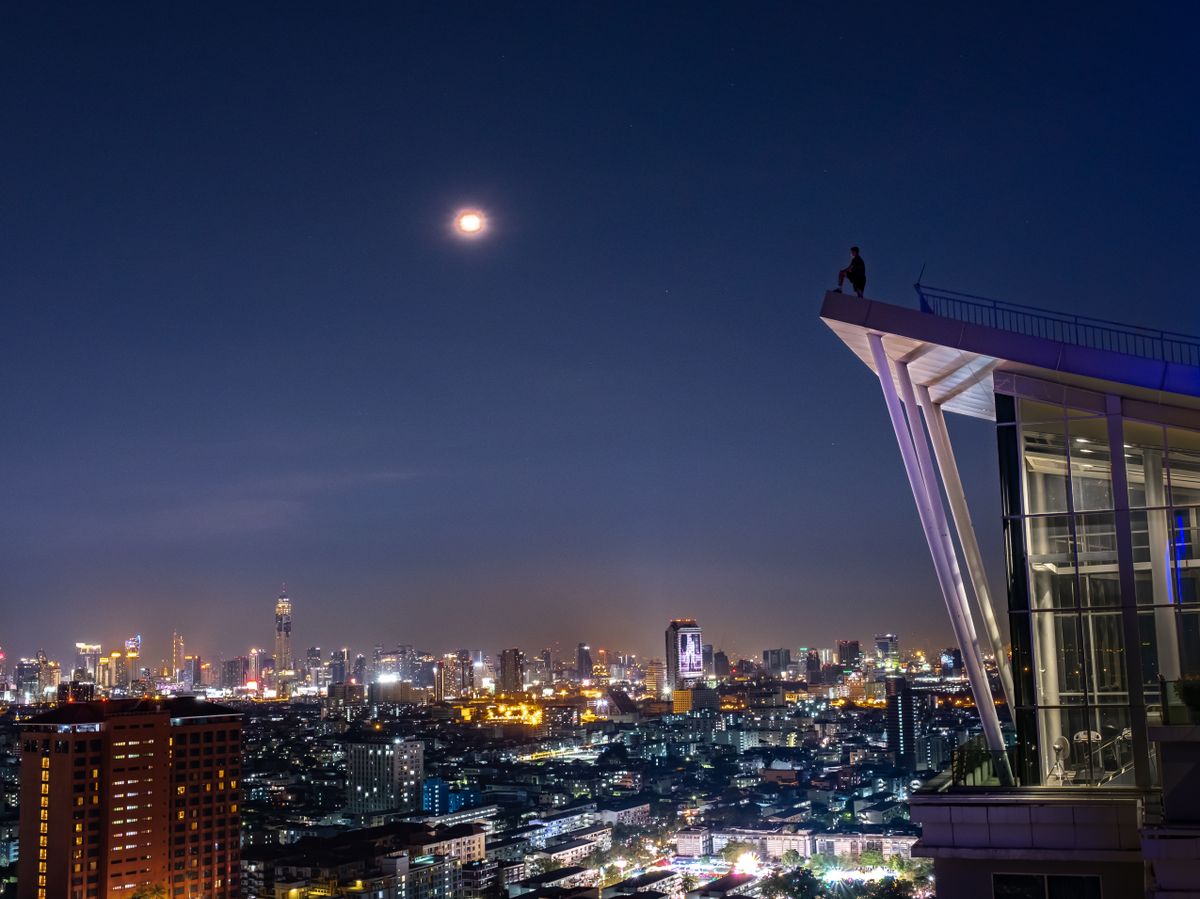
Sky Bar at Lebua is probably the most famous rooftop bar in the world. Perched at the top of State Tower under that golden dome, immortalised by a Hollywood hangover, it delivers a view so absurd that first-timers routinely go quiet at the top of the stairs. I recommend it to every visitor once. The river at night from up there is one of the great urban images of Asia.
But watch what people actually do at Sky Bar. They arrive, they inch toward the edge, they take the photograph, they hold their drink like a prop for twenty minutes, and they leave. It is a pilgrimage site, and pilgrims do not mingle. The crowd is transient, the layout funnels everyone toward the same railing for the same shot, and there is nowhere for an evening to settle. As spectacle, unmatched. As a place to meet anyone you did not arrive with, close to hopeless — the social equivalent of a waterfall: magnificent, loud, and over quickly.
Vertigo and Moon Bar at the Banyan Tree fails the sociability test in the opposite, gentler way. Sixty-one storeys above Sathorn, open to the sky on all sides, it is the most romantic of the classic rooftops — hushed, polished, the city glittering below like a circuit board. And that is precisely the point: Vertigo is engineered for the couple, not the crowd. Conversations are low. Tables are islands. Nobody circulates, because circulating would feel like interrupting.
Which makes it the wrong answer to this article’s question and a superb answer to a different one. If you have already met someone — if the connection exists and you want to give it an unforgettable backdrop — Vertigo at dusk is one of the finest third-or-fourth-date moves in the city. Just understand what you are booking: a stage for two, not a room for many.
The icons, in other words, are theatres. You attend, you are awed, you file out. For meeting people, we need architecture that behaves differently.
The Rooftops Where People Actually Talk
Octave, at the Marriott on Sukhumvit 57, is the one I recommend most often — and the reason is structural. Octave is not a terrace; it is a stack. Three levels, each with its own temperature: a relaxed lounge floor, a livelier middle, and a 360-degree crow’s-nest at the top where the crowd stands shoulder to shoulder around a circular bar with the whole city rotating slowly around them. That verticality does something subtle and important — it gives everyone a reason to move. You arrive on one floor, hear the music from another, climb to see the view from the top, drift back down. Every transition reshuffles the room.
Add a crowd that is genuinely mixed — Thonglor locals, long-term expats, well-briefed travellers — and music that stays under the conversation line for most of the evening, and you have the rare famous rooftop where striking up a conversation with the group next to you feels natural rather than transgressive. If a friend told me they were new to Bangkok and wanted one rooftop to start with, this is the one.
Above Eleven, on Sukhumvit Soi 11, is the extrovert of the family. Peruvian-Japanese kitchen, a DJ who takes the evening somewhere, and a crowd that arrives expecting the night to be social. Soi 11 has been one of Bangkok’s nightlife arteries for decades, and Above Eleven sits over it like a control tower — people come up before a big night, or instead of one. The energy is warmer and more kinetic than the icons; groups blur at the edges; by ten o’clock the distinction between “our table” and “their table” has usually stopped being enforced. If your goal is momentum — a rooftop where the evening escalates rather than plateaus — this is the strongest candidate on the list. It rewards going with two friends and an open posture.
Tichuca, above Thonglor, is the phenomenon. You will know it from a thousand photographs: the glowing jellyfish-tree rising out of the bar, the queue at the bottom of the tower that has become a Bangkok institution in its own right. Tichuca’s crowd is the youngest of the six, the music is the loudest, and the whole place runs closer to spectacle than salon — you go to be in the image as much as to talk.
And yet I will defend it, with caveats, as a social venue. The queue itself is an accidental icebreaker — a shared mild ordeal, and shared mild ordeals bond strangers faster than shared comfort ever does. Once up, the terraces are dense and fluid, and the sheer improbability of the place gives everyone the same conversation to start with. But go early rather than late, keep your expectations calibrated — this is a place for high-energy first contact, not long conversation — and treat it as one stop in an evening rather than the evening itself. It slots perfectly into the kind of multi-act night I sketched in what to do in Bangkok tonight.
CRU, crowning Centara Grand at CentralWorld, is the celebration rooftop. A champagne bar nearly sixty floors up, small, glittering, with the densest view of central Bangkok on this list. Its size is its social secret: unlike the sprawling terraces, CRU is compact enough that the whole bar shares one atmosphere, and the champagne framing means people arrive marking something — a birthday, a deal, an anniversary, a last night in the city. People in a celebratory frame of mind talk to strangers; it is one of the most reliable regularities of social life. CRU is where “what are you celebrating?” is always a legitimate question, and always gets an answer.
Notice the pattern across the four. None of them wins on altitude or fame — the icons take those prizes easily. They win on standing room, circulation, mixed crowds and permissioned conversation. The best rooftop bars in Bangkok for meeting people are not the ones with the best views. They are the ones with the best physics.
How to Actually Work a Rooftop
Knowing where to go is half of it. The other half is craft, and rooftop craft is simple enough to fit in four habits.
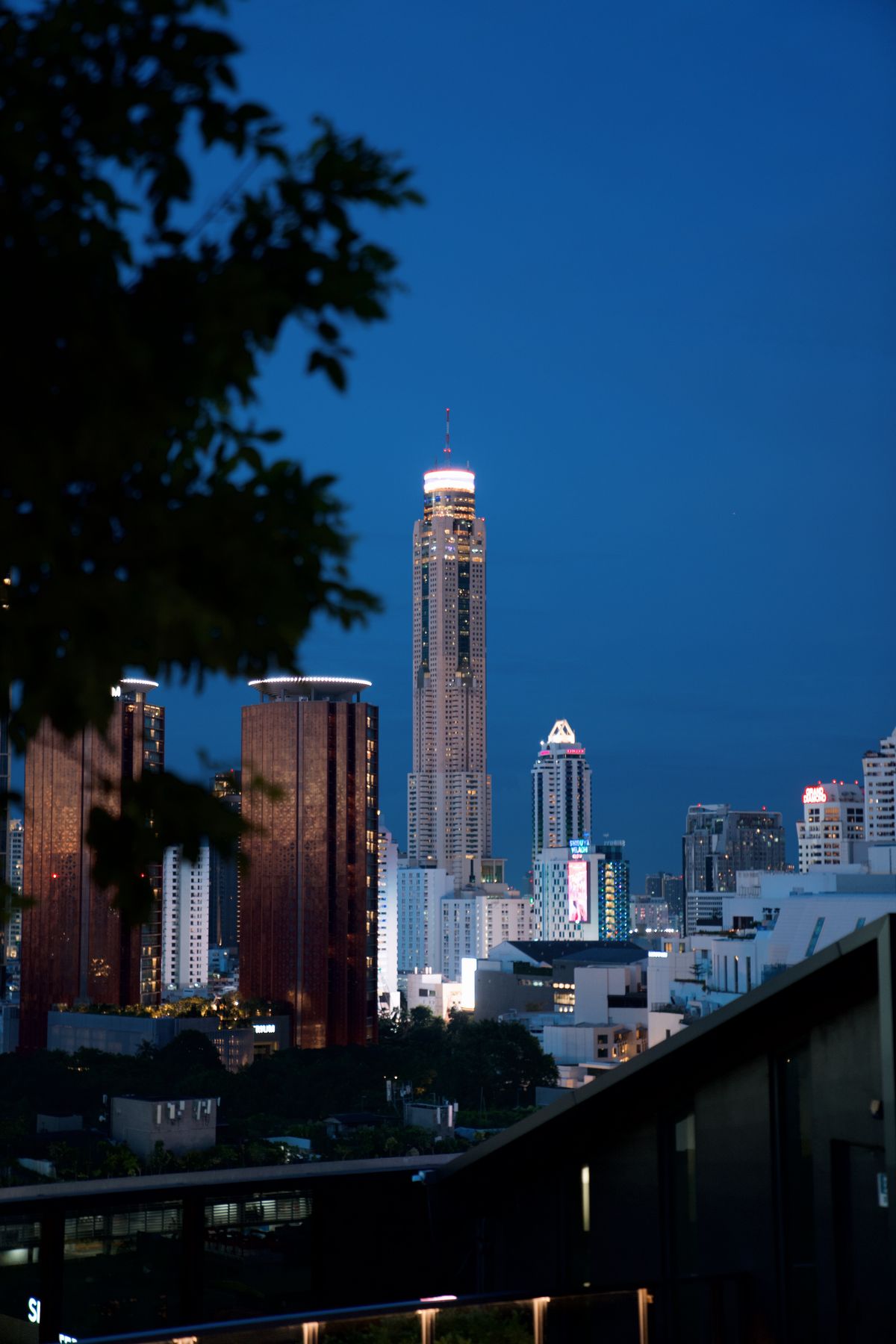
Arrive for the golden hour, not the peak. The hour around sunset is when a rooftop is at its most sociable: the light is doing the work, the spectacle is live, the terrace is filling but not yet fortified into settled groups, and everyone has a reason to be standing at the edge together. Arrive late and you join a room where every conversation has already crystallised. Arrive at six and you are present for the reshuffle — the nightly moment when the whole terrace faces west and strangers stand ten centimetres apart, visibly moved by the same thing.
Stand; don’t entrench. The single biggest self-sabotage on a rooftop is taking a table for the night. A table announces that your evening is complete. Stand at or near the bar, keep your group’s geometry open — a horseshoe, not a fortress — and you become, passively, approachable. Most social opportunity is not seized; it is simply not blocked.
Go in twos and threes. Alone on a famous rooftop is hard mode — doable, but the settings are against you. Six of you is a closed nation-state. Two or three is the magic number: complete enough to be comfortable, incomplete enough that others can join. The groups that grow over an evening almost always started small.
Use the view as the opener, because it is one. People agonise over opening lines, and on a rooftop the city has already written it. The sunset, the storm coming in over the river, the sheer oddness of the glowing jellyfish tree — remark on the shared thing, to the people sharing it, and you are in a conversation. This is not a technique so much as the oldest human reflex there is, and rooftops are one of the few adult environments that still trigger it nightly.
None of this is about performing confidence. It is about positioning — putting yourself where the architecture and the hour are working for you rather than against you. The rest, as I have argued in my broader guide to meeting new people in Bangkok, is mostly repetition: the people who build real social lives here are not the smoothest, they are the ones who show up often enough for familiarity to do its quiet work.
The Honest Limit of Every Rooftop
Now for the part the rooftop guides never include.
Even the most sociable rooftop in Bangkok is still a room full of strangers with no reason to know each other. Everything I have described — the standing culture, the golden hour, the shared spectacle — improves your odds at the margin. But the margin is where it stays, because the fundamental problem is unsolved: nobody up there knows who anyone is, nobody is expected to talk to anyone, and every approach carries the small social risk that keeps most people politely facing the skyline all night.
Julianne Holt-Lunstad’s research on social connection makes the stakes of this uncomfortably clear — the absence of real connection is a genuine health risk, on the order of the ones we take seriously. And yet the way modern cities organise social life is essentially the Sky Bar model: put many people in a beautiful place, give them drinks, and hope. Mostly, the hope does not convert. People photograph the view and go home.
This is the exact problem I started SPARK to solve, and it is why we built it the way we did. SPARK is not a dating app; it is social discovery — a verified community where people meet in real life through curated shared experiences, for friendship, romance, professional connection and everything between. The difference between a SPARK evening and a hopeful rooftop evening is intent: everyone in the room has chosen to be there to meet people, everyone is verified, and the small social risk that silences a terrace has been removed at the door. Across the 892 real-world meetings our community has completed so far, that single design change — replacing hope with intent — is the whole story.
We work with more than 3,000 partner venues across Bangkok and Singapore, and yes, some of the best evenings happen at altitude. A rooftop with a view is a wonderful place to meet people. A rooftop with a view and a room full of people who actually want to meet you is a different category of evening altogether.
Looking to meet interesting people in real life? Download SPARK or join our verified community.
FAQs
Which rooftop bar in Bangkok is best for meeting new people? Octave at the Marriott on Sukhumvit 57 is the strongest all-rounder: multiple levels keep the crowd circulating, the mix of locals and expats is genuinely broad, and the music stays low enough for conversation most of the evening. Above Eleven is the better choice if you want higher energy and a crowd that arrives expecting a social night.
Are Sky Bar and Vertigo worth visiting if I want a social night out? Visit them for the view, not the crowd. Sky Bar is a pilgrimage — spectacular and transient, with little scope for lingering — while Vertigo is designed around couples and quiet tables. Both are superb backdrops for a date you have already arranged, but poor places to meet anyone new.
When is the best time to go to a rooftop bar in Bangkok? Arrive around sunset, roughly six o’clock depending on season. The golden hour is when terraces are filling but not yet settled, the shared spectacle gives everyone a natural opening line, and standing room near the bar is still available. In the rainy season, storms usually pass in bursts — many rooftops have covered sections, and a cleared sky after rain is the best view of all.
Founder’s Note
Bangkok builds its bars in the sky, and I love it for that. But sixty floors of altitude cannot close a gap of one metre between two strangers — only intent can.
So go up. Catch the golden hour at Octave, celebrate something at CRU, let Soi 11 escalate beneath you at Above Eleven. And if you find yourself facing the skyline wishing the room were easier to talk to, remember that this is a solvable problem. We solve it every week.
The view is the invitation. The people are the point.
— Sunny Khurana, Founder & CEO, SPARK
Keep Reading
More from the Journal


Looking to meet interesting people in real life?
SPARK is a members’ community for dating, friendship and professional connection — built around curated real-world experiences in Bangkok, Singapore and, from September, New Zealand.
Or read us first — new essays on real-world connection, monthly.