The City That Refuses to End the Day
Somewhere around six in the evening, Bangkok performs a magic trick.
The heat lifts. The light turns gold, then violet. The office towers empty and the street stalls ignite, and a city that spent the afternoon idling in traffic suddenly remembers it is one of the great nocturnal capitals of the world. Rooftops fill. Woks catch fire. Somewhere near Victory Monument a saxophonist is warming up, and along the Chao Phraya the ferries start carrying people towards dinners they will still be talking about next week.
I have lived in this city long enough to stop being surprised by it, and I am still surprised by it. There are very few places on earth where the question “what shall we do tonight?” has this many good answers on a random Tuesday.
But here is the thing I have learned — from my own life, and from running a company whose entire purpose is getting people off their phones and into real rooms together. The question “what shall we do tonight?” is almost never the real question. The real question hiding underneath it is “who shall I do it with?” A rooftop at sunset is a photograph if you are alone and a memory if you are not. Chinatown at full tilt is overwhelming solo and glorious in company. Bangkok’s nights are built for two, four, eight people at a time.
So this is not a listicle of venues to tick off. It is a guide organised by mood — six kinds of Bangkok night, all of them proven, all of them available more or less any evening you want them — with one consistent piece of advice threaded through: bring someone. Or go somewhere designed to help you find your someones. Both are easier in this city than almost anywhere I know.
For the View: Rooftops at Golden Hour
Start with the obvious, because in Bangkok the obvious happens to be world-class.
This city does rooftops the way Vienna does concert halls — as a civic art form. The skyline is vast and low-rise enough at the edges that from forty floors up you can see the whole glittering sprawl of it, the river cutting through like a strip of hammered metal. Vertigo, on the roof of the Banyan Tree on Sathorn, has been serving that view for more than two decades and it still silences first-timers mid-sentence. Octave, above the Marriott on Sukhumvit 57, gives you Thonglor’s grid of lights from three stacked levels. Tichuca, with its glowing jellyfish-tree of a bar, is louder and younger and knows exactly what it is. And the Sky Bar at Lebua remains the postcard: the golden dome, the vertiginous ledge, the view that launched a thousand film scenes.
Timing matters more than the venue, honestly. Arrive about an hour before sunset. You get the daylight city, the burning sky, and the electric city, three experiences for the price of one drink — and Bangkok rooftop drinks are priced such that you will want to make each one count.
Here is my one strong opinion: a rooftop is a terrible place to spend a whole night and a perfect place to start one. The format is a view plus a drink; it peaks early. Treat it as act one — the place where the conversation gets its altitude — then descend into the streets for act two. If you want the full tour of the skyline options, I have written a dedicated guide to the best rooftop bars in Bangkok that goes floor by floor.
And notice something about rooftops: nobody goes alone. The view is a social instrument. It exists to be pointed at, gasped at, argued over. Which is rather the theme of this whole piece.
For the Buzz: Night Markets
If rooftops are Bangkok’s overture, night markets are its full orchestra.
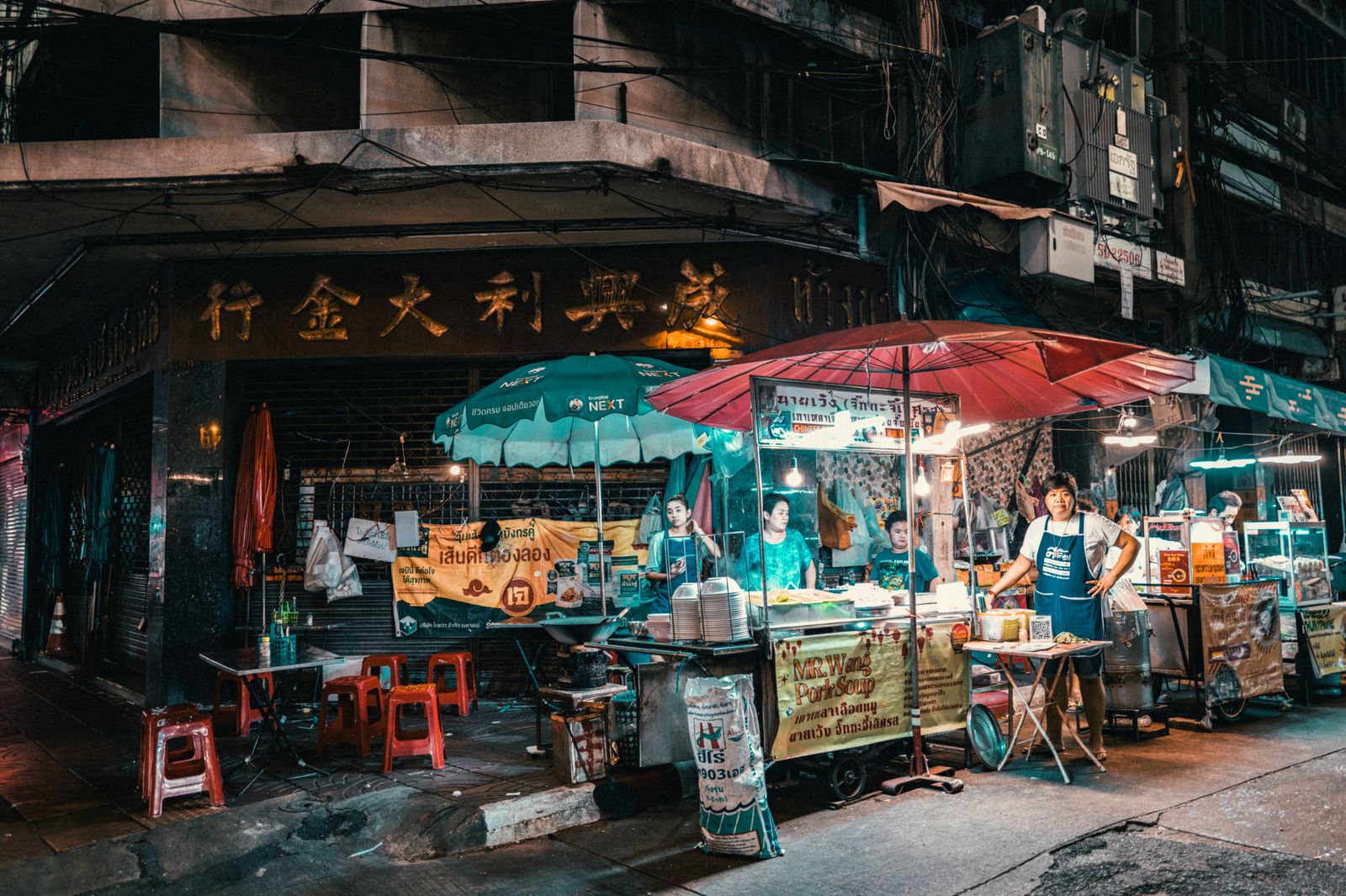
Yaowarat — Chinatown’s main artery — on any evening is one of the great free spectacles of Asia. Neon stacked on neon, woks roaring, queues snaking from stalls that have been perfecting one dish for three generations. You do not so much walk down Yaowarat as get carried down it, grazing as you go: grilled prawns, kuay jab pepper broth, mango sticky rice, toast stalls with lines that defy logic. It is chaotic, cheap and completely alive.
Further out, the Talad Rot Fai night market on Srinakarin turns evening shopping into theatre — vintage cars, retro Americana, mountains of secondhand treasure and street food in every direction. Jodd Fairs, its central-city sibling near Rama IX, delivers the same formula with less of a journey. These places are not really about buying anything. They are about wandering, pointing, sampling and debating, which is why they are so much better with company: a market visited alone is shopping, but a market visited together is a game.
There is a quiet psychology to this. Shared attention amplifies experience — we enjoy things more, and remember them better, when someone beside us is experiencing them at the same moment. The mere-exposure effect, psychology’s most reliable finding about liking, adds a second layer: we grow fonder of people through repeated, low-pressure contact. A night market supplies exactly that — two hours of easy, side-by-side, no-eye-contact-required togetherness, punctuated by grilled squid. It is, not coincidentally, one of the formats I recommend most often in my guide to the best date ideas in Bangkok. But it works precisely as well for new friends as for new romances.
For the Soundtrack: Live Music and Jazz
Bangkok’s live music scene is one of its best-kept open secrets, and it splits neatly into two moods.
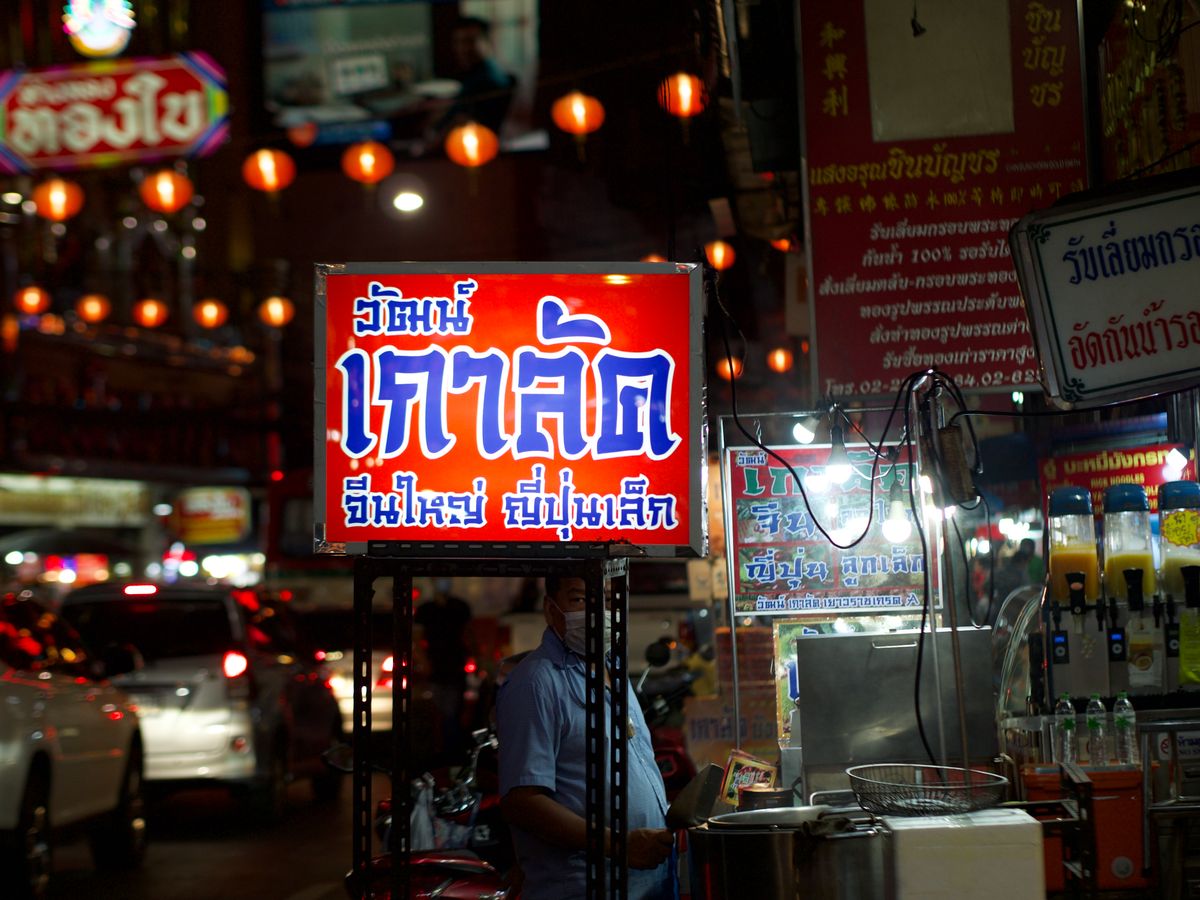
Mood one is the institution. Saxophone Pub, in the shadow of Victory Monument, has been putting blues, jazz and funk on its small stage since the 1980s; it is dim, loud, unpretentious, and exactly what a music pub should be. Brown Sugar, one of the city’s longest-running jazz rooms, delivers the classic experience — close tables, serious players, a crowd that actually listens. At the other end of the spectrum of formality sits The Bamboo Bar at the Mandarin Oriental, pouring impeccable cocktails to a live band in a room that has hosted jazz by the river since before most of us were born.
Mood two is the neighbourhood. Charoenkrung and Talad Noi hide listening bars and small venues down their sois; Phra Athit, near the old city, has a strip of small bars where Thai singer-songwriters play to rooms of thirty people; Ekkamai and Thonglor trade in everything from indie bands to DJ sets.
Live music is the great social lubricant for people who dread small talk, and I say that as someone who has watched hundreds of first meetings happen. The music does the heavy lifting. You can sit beside someone in comfortable silence and it reads as companionship, not awkwardness. You can lean over and say “she’s brilliant” and you have a conversation. For a first meeting with anyone — a date, a new acquaintance, a colleague you would like to become a friend — a small room with a good band is close to cheating.
For Slowing Down: The Riverside After Dark
Some nights you do not want volume. You want the river.
The Chao Phraya after dark is Bangkok at its most cinematic, and its pleasures cost almost nothing. Catch the Chao Phraya Express Boat or the ferry between piers and watch the city slide past: Wat Arun lit up like a jewelled rocket, the Grand Palace glowing gold, longtail boats stitching wakes across the black water. Walk the riverside from the old customs house through Talad Noi’s street art and shrine-scented alleys. Sit on the terrace at Tha Maharaj with something cold. Cross to ICONSIAM if you want polish and air-conditioning, or to Asiatique if you want a ferris wheel with your night breeze.
The riverside night is the conversational format. Walking side by side along water is the oldest deep-talk technology humans possess — the rhythm of walking loosens thought, the view gives silence somewhere to rest, and the gentle forward motion means nobody is trapped. Robert Putnam wrote about how communities are held together by the accumulation of exactly this kind of unhurried, face-to-face time; he was writing about bowling leagues in America, but he could have been describing two friends on the Wat Arun ferry at nine in the evening.
This is the night to plan when the conversation matters more than the setting — the catch-up with a friend you have been rescheduling for a month, the second meeting with someone you suspect might become important. Let the river do the pacing.
For Midnight Hunger: Late-Night Eats
Bangkok has no real closing time, and its kitchens know it.
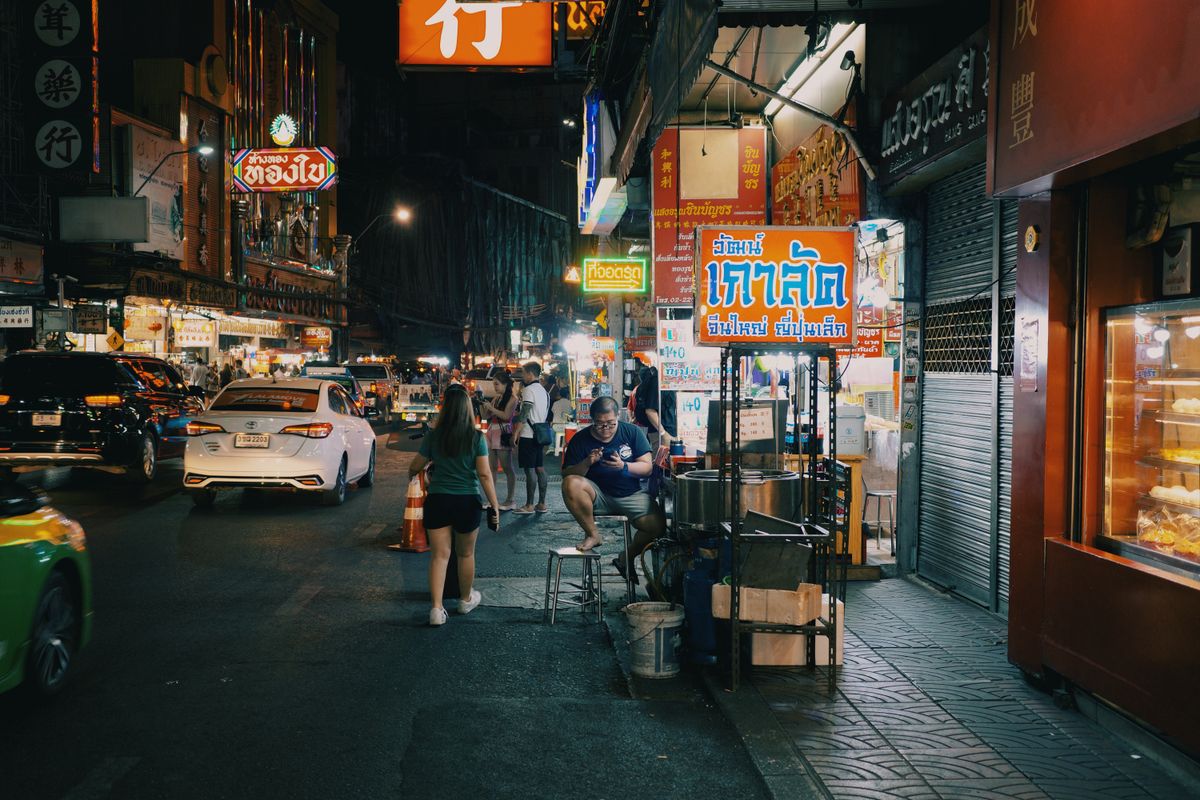
When the rooftops shut and the bands pack up, the city simply moves to plastic stools. Chinatown keeps feeding people deep into the night — this is the land of Jay Fai’s legendary crab omelette, of noodle stalls whose broth has been evolving for decades, of oyster omelettes crisped over charcoal at hours when most cities are asleep. Around Victory Monument, the boat noodle alley serves tiny, intense bowls you order by the stack. Across town, all-night khao tom (rice soup) houses do for Bangkok what the diner does for New York: fluorescent light, huge menus, no judgement, open when you need them.
The late-night meal is the most underrated social institution in this city. It is where the actual conversation of the evening happens — the debrief, the confession, the plan for next time. The rooftop was the trailer; the 1 a.m. noodle stool is the film. Some of the best friendships I have made in Bangkok were sealed not at the event we attended but at the food afterwards, and I have come to believe the pattern is universal: never end the night at the venue. End it at the noodles.
If you are new here and reading this list with the slightly hollow feeling of having no one to eat the noodles with yet — I have been there, and I wrote a practical guide to how to meet new people in Bangkok precisely for that stage of city life. The hollow feeling is a logistics problem, not a verdict. It responds very well to deliberate action.
For a Quieter Kind of Night: Galleries and Creative Evenings
Not every good night is loud, and Bangkok’s creative scene has grown a proper evening life.
The Bangkok Art and Culture Centre — the great white spiral opposite MBK — anchors it: rotating exhibitions across multiple floors, free to enter, and open into the evening, which makes it one of the city’s best starts to a cultured night out. Down in Charoenkrung and Talad Noi, the city’s unofficial arts district, galleries and creative spaces cluster along the old shophouse streets, and on opening nights the neighbourhood hums with people drifting between exhibitions, wine glasses in hand. River City Bangkok, by the Chao Phraya, stacks galleries and auction houses into one complex and pairs conveniently with the riverside walk above.
Gallery nights are socially brilliant for a reason people rarely articulate: art is a licence to talk to strangers. Standing in front of the same painting as someone else is one of the very few situations in modern life where opening a conversation feels natural rather than intrusive. The work gives you the subject; the room gives you the permission. This is the propinquity effect in action — proximity plus a shared focus, the same quiet mechanism that builds friendships in offices and classrooms, borrowed for a Thursday evening.
An evening built on culture also filters for curiosity, which is the trait I would tell anyone to select for — in friends, in partners, in colleagues. The people you meet at an exhibition opening are, almost by definition, people who leave the house to be interested in things. Those are your people.
The Real Question Is Who, Not What
Read back through this list and you will notice that I have quietly repeated one move six times. Every mood — the rooftop, the market, the jazz room, the river, the noodles, the gallery — got the same footnote: it is better with people.
That is not sentimentality. It is the closest thing social science has to a consensus. Julianne Holt-Lunstad’s meta-analyses put the health cost of chronic disconnection on par with the most serious lifestyle risk factors we know. Jeffrey Hall’s research at the University of Kansas found that friendship is built from hours — many of them, accumulated through repeated time together — which means the couple of hundred evenings you will spend in this city each year are not entertainment. They are the raw material of your actual life.
And yet the hardest part of a Bangkok night has never been finding something to do. It is having people to do it with — especially if you are new, or your social circle has thinned to colleagues and a group chat that never converts into plans. The city is generous; the introductions are the bottleneck.
That bottleneck is the entire reason SPARK exists. We are not a dating app. We are building social discovery: a verified community of people who want real friendships, real dates, real professional connections — formed in person, not in message threads. We organise curated experiences across the city — supper clubs, gallery evenings, rooftop meet-ups, market crawls, live music nights — with more than 3,000 partner venues across Bangkok and Singapore giving our members rooms worth walking into. More than 1,397 of our members have now met in person, and the pattern behind those meetings is exactly the pattern of this article: not “swipe, chat, fizzle” but “turn up, do the thing, eat the noodles after”.
Tonight, in other words, is not just an evening to fill. It is a rep. The people who end up with rich lives in this city are the ones who treat their evenings as invitations — who pick the mood, send the message, and go.
Looking to meet interesting people in real life? Download SPARK or join our verified community.
FAQs
What is the best thing to do in Bangkok tonight if I’m short on time? Do the classic two-act night: a rooftop at golden hour — Vertigo, Octave or the Sky Bar at Lebua — followed by street food in Chinatown. In roughly four hours you get the skyline, the sunset, and one of the world’s great food streets. It is the highest-density introduction to Bangkok’s evenings that exists.
What can I do in Bangkok tonight without spending much? The river is your friend. The Chao Phraya ferries cost next to nothing and deliver the city’s most cinematic views of Wat Arun and the Grand Palace lit up; pair the crossing with a riverside walk through Talad Noi and a street-food dinner in Yaowarat. Bangkok consistently rewards curiosity over spending.
How do I find people to go out with in Bangkok if I’m new here? Choose activities that make meeting others natural — gallery openings, live music rooms, group experiences — rather than hoping encounters happen at bars. Structured, recurring settings beat one-off luck because friendship is built through repeated time together. Communities like SPARK exist precisely to supply those settings, with verified members and curated experiences across the city.
Founder’s Note
Bangkok will always hold up its end of the bargain. The rooftops will glow, the woks will roar, the river will run silver past the temples, tonight and every night, whether you show up or not.
Your end of the bargain is smaller but harder: decide that tonight counts, and bring someone — or go somewhere you might find them. Cities do not build your life. Evenings do, one at a time, in company.
Pick a mood from this list. Send the message. Go.
— Sunny Khurana, Founder & CEO, SPARK
Keep Reading
More from the Journal


Looking to meet interesting people in real life?
SPARK is a members’ community for dating, friendship and professional connection — built around curated real-world experiences in Bangkok, Singapore and, from September, New Zealand.
Or read us first — new essays on real-world connection, monthly.