
Walk into almost any café this afternoon — in Bangkok, in Singapore, in Auckland — and you will see two people sharing a conversation that could quietly change both of their lives. A first date that becomes a marriage. A coffee that becomes a company. A chat between strangers that becomes a twenty-year friendship.
Now consider everything the technology industry celebrates about the moments before that conversation. Matches. Likes. Followers. Streaks. Messages sent. Time spent in-app. An entire economy of metrics, dashboards and quarterly investor updates, all built around the prelude — and almost nothing built around the conversation itself.
When we started SPARK, we kept returning to one deceptively simple question, and it eventually became the only metric we truly care about:
Did two people actually meet?
Not match. Not message. Meet. In person, across a table, in the same room, breathing the same air. Everything else is theatre. This essay is my attempt to explain why I believe the gap between matching and meeting is the connection industry's real failure — and why closing it is the most valuable thing a technology company can do this decade. It is the companion piece to the story of why we built SPARK in the first place.
The World's Most Valuable Metric Nobody Measures
Technology has become exceptionally good at introducing people. This is worth pausing on, because it is a genuine miracle that we have all stopped noticing. A generation ago, the pool of people you could plausibly meet was defined by your street, your office, your temple or church, and the friends of your friends. Today, an app can show you a thousand compatible strangers before breakfast.
Finding someone is no longer difficult. Meeting them is.
Between discovering a person and sitting across a table from them lies an invisible gap, and it is inside that gap that most potential relationships quietly disappear. The match that never became a message. The message that never became a plan. The plan that was postponed twice and then softly abandoned. Nobody mourns these losses because nobody sees them. There is no notification for a friendship that failed to happen.
Here is the uncomfortable truth about why this gap persists: for most platforms, the gap is not a bug. It is the business model. An app that earns its revenue from attention has no incentive to get you off your phone and into a wine bar. The unmet match is, commercially speaking, the ideal customer — perpetually hopeful, perpetually scrolling, perpetually monetisable. I do not say this cynically; the people building these products are mostly thoughtful and well-intentioned. But incentives are gravity. Optimise a system for engagement and it will, with great efficiency, produce engagement — while the metric that actually matters to human beings goes unmeasured, unreported and unrewarded.
At SPARK we made ourselves accountable to the opposite number. As I write this, our community has completed 892 real-world meetings — coffees, dinners, gallery walks, morning runs. It is a small figure next to the billions of matches the industry generates, and I am prouder of it than any download chart, because every single one represents two people who crossed the gap.
The Funnel Everyone Accepts
Every meaningful relationship in your life — romantic, platonic, professional — followed roughly the same journey. You discovered each other. You connected. You talked. You met. And then, over time and repeated presence, you built trust.
Discover. Connect. Talk. Meet. Build trust.
The strange thing about the modern connection industry is that it has poured extraordinary talent and capital into the first three steps and essentially outsourced the fourth to chance. Discovery has been refined to an art form: recommendation algorithms, interest graphs, elaborate compatibility scores. Connecting is a single gesture, engineered to be as frictionless as a heartbeat. Talking is supported by prompts, icebreakers and, increasingly, AI-suggested openers.
And then, at the precise moment when the stakes become real — when two humans must agree on a time, choose a place, overcome nerves and actually show up — the product shrugs. You're on your own now. Good luck out there.
Imagine an airline that perfected the booking experience, the seat selection and the boarding passes, but considered the actual flight to be outside its remit. We would find that absurd. Yet this is precisely the shape of most social technology: exquisite at the funnel's top, absent at the moment of truth.
The consequences are not trivial. Julianne Holt-Lunstad's meta-analyses at Brigham Young University established something that ought to reframe how seriously we take all of this: the presence or absence of strong social connection is a predictor of mortality on a par with the most established lifestyle risk factors, comparable in its magnitude to smoking. Loneliness is not a mood. It is a health condition with a body count. If the systems that mediate how people find one another are systematically failing at the final step, that is not a product niggle. It is a public health failure wearing a friendly interface.
There is a second cost, subtler but just as corrosive: learned helplessness. When someone matches two hundred times and meets no one, they do not conclude that the funnel is broken. They conclude that they are. The industry's silent attrition gets internalised as personal failure, and people withdraw — from the apps, and often from trying at all. Anyone who has attempted making friends in Bangkok as a newcomer will recognise the feeling: surrounded by millions of people, and somehow further from them than ever.
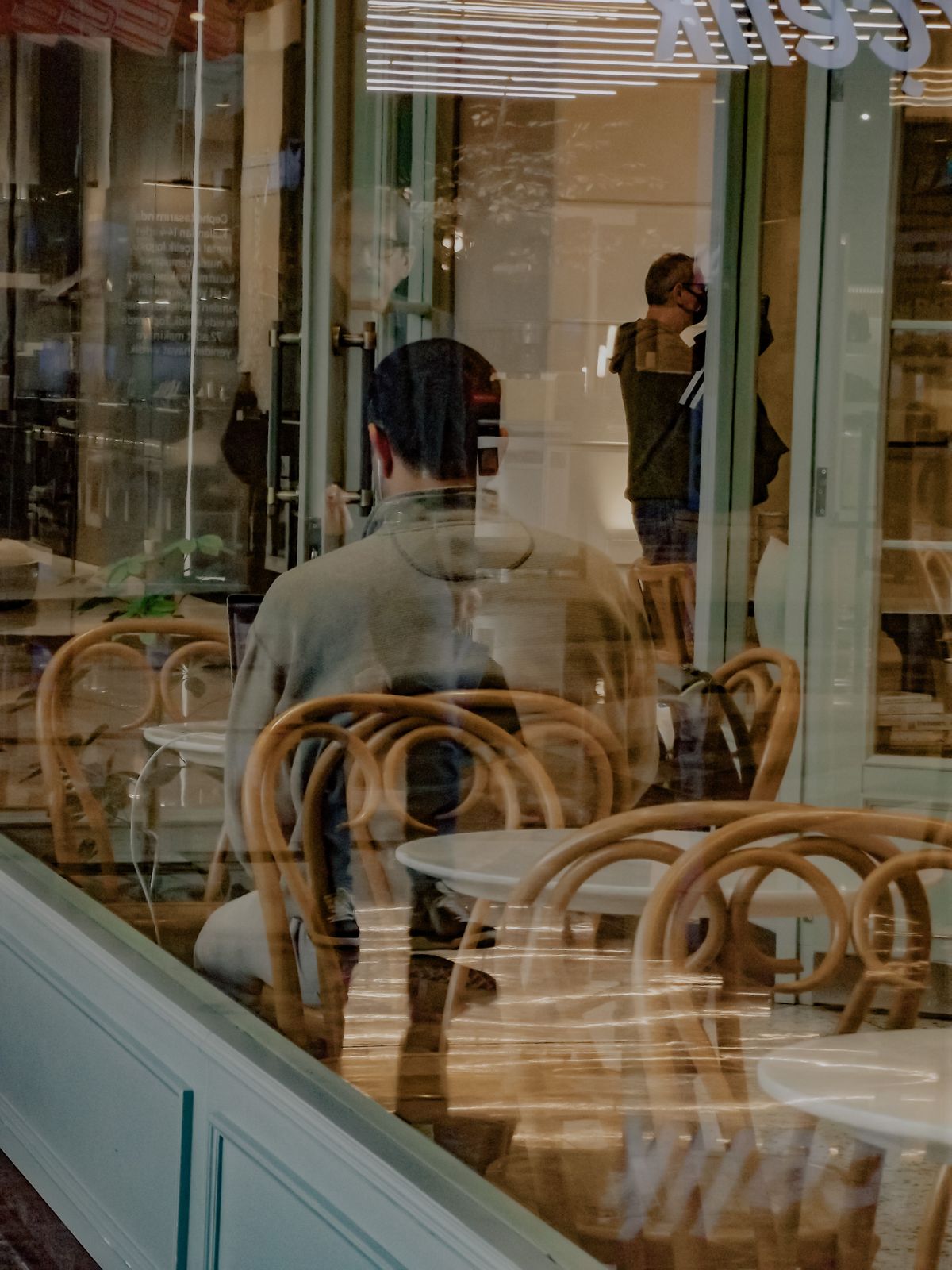
Chemistry Doesn't Live Inside a Chat Window
There is a deeper problem than incentives, and it is epistemological: the thing you are trying to establish — whether you and another person genuinely connect — cannot actually be established through text.
Compatibility on paper is a weak signal. Two people can share a love of jazz, hiking and Thai food and have nothing to say to each other. Two people with almost no overlapping interests can talk until the restaurant staff start stacking chairs. What decides it is not the inventory of preferences; it is chemistry, and chemistry is stubbornly physical. It lives in eye contact and its timing. In whether your laughter overlaps. In how someone treats a waiter, how they listen, whether their curiosity is real or performed. In the thousand micro-signals that our species spent hundreds of thousands of years learning to read — none of which survive compression into a chat bubble.
The research here is quietly devastating for the message-forever model. Jeffrey Hall's 2018 work at the University of Kansas found that friendship is, above all, a function of accumulated hours together — on the order of fifty hours to move from acquaintance towards casual friendship, and a couple of hundred hours in shared company before someone becomes a close friend. Hours. Presence. Repetition. Robin Dunbar's decades of work on the layers of friendship points the same way: the closer the bond, the more time and embodied interaction it demands, and no technology has ever been able to fake the substrate. Psychologists have long observed the same pattern from another angle — the propinquity effect, the finding that we form bonds with the people we repeatedly, physically encounter, and the mere-exposure effect, our tendency to warm to what we regularly see. Every serious finding in the science of human bonding points in the same direction: towards rooms, not screens.
Endless pre-meeting chat does not merely fail to build chemistry. It often actively destroys the conditions for it. Weeks of messaging construct an imagined person — wittier, taller, more compatible than any human could be — and the real one, arriving at the café, is asked to compete with a fiction. Many perfectly promising pairings have been quietly killed by their own text history. The kindest thing two matched people can do for their prospects is to meet soon, somewhere good, while curiosity is still fresh.
Designing Around Real Life
Here is what I find genuinely exciting: the moment you make the meeting the goal, rather than the match, almost every product decision changes. It is like rotating a building ninety degrees — the same materials, an entirely different structure.
Verification stops being a compliance checkbox and becomes the foundation. Nobody hesitates to message a stranger; everybody hesitates to sit alone at a table waiting for one. If your product's endpoint is a real-world meeting, then knowing that every member is a verified, real, accountable human is not a premium feature. It is the ground the whole thing stands on. This is why SPARK is a verified community with an application process, and why we treat safety as architecture rather than as a settings page.
Places stop being an afterthought and become part of the product. "Drinks sometime?" is where plans go to die. "Thursday, 7pm, that natural wine bar in Thonglor" is a plan. The single biggest reducer of no-shows is not a better algorithm; it is the removal of logistical friction — a time, a place, a reason. So we built the venue layer directly into SPARK: more than 3,000 partner venues across Bangkok and Singapore, so that the step from "we should meet" to "we are meeting" is one tap rather than a week of negotiation. Our curated experiences exist for the same reason — a supper club, a gallery evening or a run club gives two strangers a shared context, which is the oldest social technology there is.
Quality starts to matter more than quantity. A feed optimised for engagement wants infinite candidates; a product optimised for meetings wants the right few. Showing someone five hundred faces a day is trivially easy and almost worthless. Helping them meet five genuinely resonant people in a month is hard and changes their life.
And the definition of success inverts. A conventional app succeeds when you open it constantly. SPARK succeeds when you open it briefly, make a plan, and put your phone away. We are, quite deliberately, building software whose purpose is to be closed.

From Dating to Social Discovery
Somewhere along the way, the industry decided that technology-mediated connection meant romance, and only romance. This has always struck me as a strange narrowing. Think honestly about the meetings that shaped your life. Some were romantic. But many were not: the mentor who saw something in you before you did, the co-founder you met at a dinner you nearly skipped, the friend from a Tuesday run club who became family, the stranger at a talk in Singapore who is now your business partner.
The relationship changes. The meeting doesn't.
Discover, connect, talk, meet, build trust — the funnel is identical whether the destination is love, friendship, mentorship or collaboration. And crucially, the failure point is identical too. It is always the gap. The person searching for ways to meet new people in Singapore and the person hoping for a great first date are, structurally, facing the same problem: plenty of discovery, precious little meeting.
That is why SPARK is not a dating app, and why we resist the label even when it would make us easier to explain at parties. We are building a different category, which we call social discovery: verified people, curated real-world experiences, and every kind of human connection under one roof — romantic, platonic, professional, communal. On the same platform, in the same week, a member might go on a first date they found through our guide to Bangkok's best date spots, join a founders' dinner, and turn up to a Sunday hike with eleven strangers who won't stay strangers for long.
There is also a compounding effect that single-purpose apps structurally cannot capture. Robert Putnam's work on social capital describes how connection breeds connection — every relationship is a bridge into another person's entire world of relationships. The friend introduces you to the partner. The mentor introduces you to the co-founder. A community designed around real meetings doesn't grow linearly; it weaves. We see this in our own numbers: the majority of SPARK's growth is organic, members bringing the people they care about into the rooms they've come to love. You cannot buy that with an advertising budget. You can only earn it, one good evening at a time.
The Future of Connection
I want to be precise about the claim I am making, because it is easy to mistake this essay for nostalgia — a Luddite's lament dressed in founder's clothing. It is the opposite. I am deeply optimistic about technology's role in human connection. I simply think we have been pointing it at the wrong target.
Life changes when people meet. Not when they match. Not when they exchange messages. Every marriage, every friendship, every partnership you have ever admired began the same way: two people in the same place at the same time, paying attention to each other. Technology's highest purpose in this domain is not to simulate that moment or substitute for it. It is to cause it — more often, more safely, with better people, in better places — and then to get out of the way.
I believe the next decade belongs to the builders who understand this. The engagement era of social technology is ending, not because regulators will end it but because people are exhausted by it. You can feel the turn in every conversation: the group chats going quiet, the quiet pride with which people mention their screen-time going down, the hunger — visible from Bangkok to Auckland, where we launch next — for third places, supper clubs, run crews, book bars, anything real. The demand for genuine meeting has never been higher. The supply of infrastructure for it has never been thinner.
That is the gap SPARK exists to close. Less time online, more time together. Fewer matches, more meetings. Software that measures itself not by the hours it captures but by the relationships it creates.
Match is easy. Meeting is hard. We chose the hard thing, because the hard thing is the whole point.
Looking to meet interesting people in real life? Download SPARK or join our verified community.
FAQs
Is SPARK a dating app? No — and the distinction is the whole thesis of this essay. SPARK is a social discovery platform: a verified community designed to help people meet in real life for dating, friendship, professional connection and mentorship alike. Romance is one beautiful outcome among many; the real product is the meeting itself.
Why does SPARK insist on verification and an application process? Because our endpoint is a real-world meeting, not a chat thread. It is easy to message a stranger and much harder to sit across a table from one, so trust has to be built into the foundations. Verification means every person you meet through SPARK is a real, accountable human — which changes how willing people are to actually show up. You can read more about our approach on our safety page.
How does SPARK actually help people cross the gap from matching to meeting? By removing the friction where plans usually die. Members connect around concrete, curated experiences and a network of partner venues, so "we should meet up" becomes a specific table at a specific time in one step. Shared context — a supper club, a gallery evening, a run — does the rest, because strangers bond far faster around a common experience than around a blank chat window.
Founder's Note
I've often asked myself a question that sounds naive and, I've come to believe, is anything but: what if we measured technology by the quality of the relationships it creates, rather than the amount of time people spend using it?
Every important decision at SPARK — verification, curated experiences, partner venues, the refusal to be just another dating app — is downstream of that one question. It is why the number I check first is never downloads or daily active users, but how many of our members actually met this week. The day that number stops growing is the day we have failed, whatever the other dashboards say.
If this essay resonated with you, the best thing you can do is beautifully simple: take one of your matches, one of your dormant connections, one almost-friendship — and turn it into a table for two this week. Meeting is hard. It is also, I promise you, worth it.
— Sunny Khurana, Founder & CEO, SPARK
Keep Reading
More from the Journal



Looking to meet interesting people in real life?
SPARK is a members’ community for dating, friendship and professional connection — built around curated real-world experiences in Bangkok, Singapore and, from September, New Zealand.
Or read us first — new essays on real-world connection, monthly.