
New Zealand has a reputation problem, and it is an unusual one: the country is almost universally described as friendly, and yet the people who move here keep telling me the same quiet story. The barista remembers their order by week two. The neighbour waves. Colleagues are warm, helpful, unfailingly pleasant. And on Saturday night, eighteen months in, their phone does not ring.
I have heard this story from members, from friends of friends, and from people who cornered me at dinners once they learned what SPARK does. It is told sheepishly, as though it were a personal failure: surely, in a country this welcoming, the fault must be mine. It is not. What these people have run into is one of the most consistent patterns in modern migration: the gap between a friendly country and an open one. New Zealand is magnificently friendly. It is not, in the way newcomers expect, open. Understanding why is the difference between a decade of pleasant acquaintances and an actual life here.
The Closed Warmth of Small Countries
Here is the structural fact underneath the pattern. In a country of five million people, where a large share of the population still lives within driving distance of where they grew up, social circles are not assembled in adulthood. They are inherited. The average Aucklander or Cantabrian has a circle built from school, university, a first job, and a sports club joined at age nine, a structure that has been compounding for decades before you arrived. It is not that Kiwis are unwilling to add people. It is that their circles are finished in the way a house is finished: you can be a welcome guest, but nobody is drawing up plans for a new wing.
This is why the standard newcomer strategy fails so reliably. The standard strategy is to be likeable and available, to accept invitations, to say “we should catch up sometime” and mean it. In cities built on churn (London, Singapore, Dubai), this works, because everyone is provisional and circles are permanently under construction. In New Zealand the same behaviour produces warmth without traction. Everyone means the catch-up sincerely. It simply never becomes load-bearing, because their Saturdays were allocated in 2009.
The correction is not to try harder at individual friendships. It is to stop knocking on the doors of finished houses and go instead to where structures are still being built. And this is where New Zealand, having posed the problem more sharply than almost anywhere, also offers the best solution I have seen in any country we operate in.
The Country Where the Clubs Never Died
Robert Putnam’s work on social capital gave us the defining image of modern disconnection: the American who bowls alone, in a country where the leagues, lodges, and civic associations that once wove strangers together had quietly emptied out. Putnam’s argument was that these institutions were never really about bowling. They were machines for converting strangers into familiars: structures that manufactured repetition, and therefore trust, as a by-product of doing something else.
The single most important thing to understand about New Zealand is that here, the leagues never died. This is a country that still runs, to a remarkable degree, on clubs. Rugby clubs, cricket clubs, tramping clubs, surf lifesaving clubs, sailing clubs, rowing clubs: institutions with clubrooms and committees and working bees, many of them over a century old, all of them structurally incapable of leaving you alone once you have turned up three times. The volunteer ethic that sustains them is not nostalgia; it is the operating system. When people say New Zealand is a village of five million, this is what they mean. The village is not a mood. It is infrastructure.
For a newcomer, this changes the entire brief. You are not trying to be adopted by a circle, which is nearly impossible. You are trying to join an institution, which is nearly automatic. A Kiwi who would never think to invite a pleasant colleague into his weekend will hand a stranger a paddle, a bib, or a sausage to barbecue within minutes of that stranger joining his club, because the club supplies what the friendship cannot yet: a reason for you to be there. Membership is a licence to belong before anyone knows you well enough to want you around. That sequence (belonging first, friendship second) is the reverse of how most of us think social life works, and it is precisely how it works here.
Jeffrey Hall’s research at the University of Kansas explains why the club route is not merely pleasant but efficient. Hall found that friendship is largely a function of accumulated hours: roughly fifty shared leisure hours to make a casual friend, around ninety for a real one, and something like two hundred for a close one. A club is a machine for accumulating exactly those hours without anyone having to organise them. Nobody is sending brave little messages proposing coffee. The season does the scheduling. Twenty Saturdays of winter sport is sixty or eighty hours in shared weather, and by September the maths has done its work whether or not anyone was trying.
The Outdoors Is Not a Hobby Here
The second thing a newcomer must recalibrate is the role of the outdoors, because in New Zealand it is not a leisure category. It is the social venue.
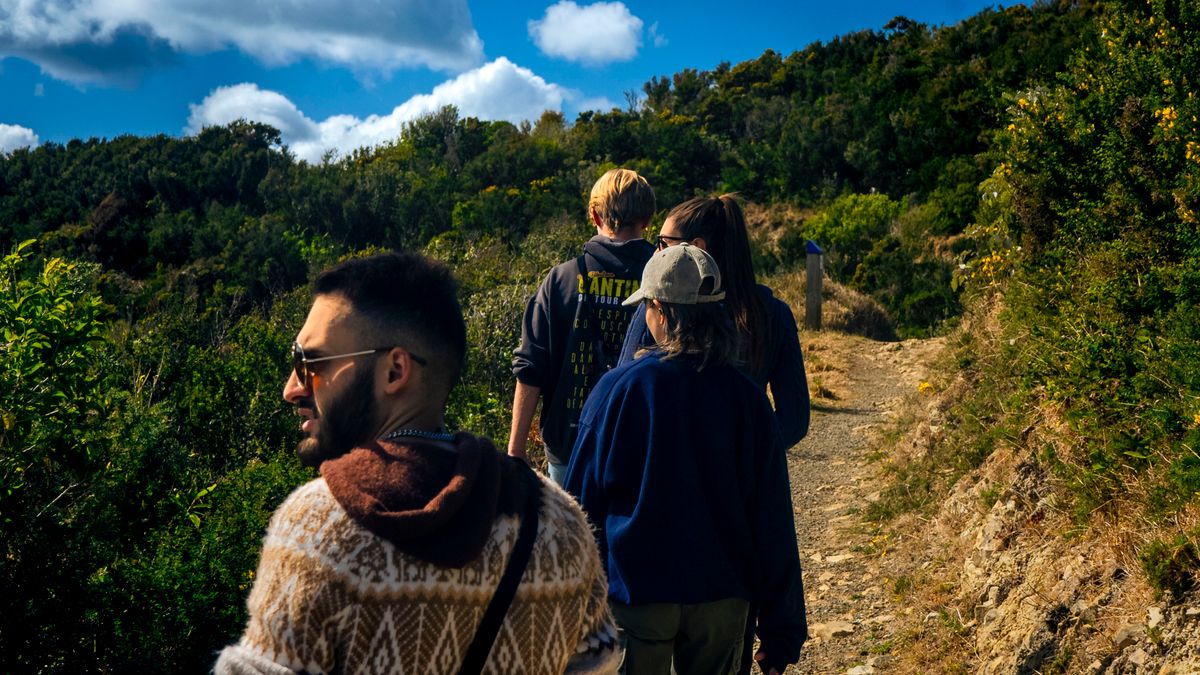
In most countries, the default third place is commercial (the pub, the restaurant, the café), and social life is something you buy by the round. New Zealand has all of that, and Auckland’s food scene in particular deserves its growing reputation. But the deep social life of this country happens outside: the coastal walk, the tramp, the beach in every season, the boat somebody’s uncle keeps on a mooring. Auckland alone is a city threaded between two harbours and nearly fifty volcanic cones, where the Waitākere Ranges and the black-sand surf beaches at Piha sit forty minutes from the office towers, and where the Saturday question is less “where shall we go out?” than “what shall we go and do?”
This matters strategically, for two reasons. The first is that outdoor formats are structurally better at making friends than indoor ones. Psychologists call it the mere-exposure and propinquity effect (we come to like the people we repeatedly share space and routine with), but the outdoors adds an accelerant: shared mild adversity. Nobody bonds at a drinks reception the way two people bond halfway up a ridgeline in horizontal rain. A walking group that meets weekly will outperform a monthly networking mixer by an order of magnitude, a phenomenon I have written about elsewhere in why most networking events fail.
The second reason is seasonal. New Zealand’s social calendar breathes: it expands enormously from November to March (barbecue season, beach season, the long light evenings when the whole country seems to migrate outside) and contracts into winter, when the sport and the club calendar take over. A newcomer who arrives in spring should treat that first summer as a land grab, saying yes to everything, because summer is when the country is at its most porous. A newcomer who arrives in autumn should join something with a winter season immediately, because winter here is when clubs do their deepest work. Either way, the principle is the same one I gave newcomers to Bangkok in my guide to building a circle there: commit to formats, not events. Only the weather wearing the formats is different.
Auckland, and the Tyranny of the Harbour Bridge
A word about geography, because Auckland (where most new arrivals land, and where SPARK is now live) punishes those who ignore it.
Auckland is a low-slung, water-severed, car-shaped city of one and a half million people spread across an isthmus, and its social physics resemble Los Angeles more than London. The harbour bridge and the motorway system partition the city into tribes: the North Shore, the central isthmus, the West, the East, the South. Aucklanders cross these lines for work and family and rarely for a casual Tuesday. A friendship that requires crossing the bridge at six in the evening is a friendship on a countdown.
So choose a village and build in it. If you live centrally, your life is Ponsonby and Karangahape Road, the Domain and Cornwall Park, the parkrun you can reach in fifteen minutes. If you are on the Shore, it is the beaches and the ferry and clubs on your own side of the water. The ferry to Waiheke and the summer expedition to the west coast are for occasions; your circle needs to live within twenty minutes of your front door, because repetition is the whole game and traffic is its natural predator. This is the same advice I give in every city we operate in, and Auckland is the city where it is most true.
One more local note: learn the rhythm of the marae-inspired generosity that runs through New Zealand life (the working bee, the shared kai, the assumption that showing up to help is a normal way for strangers to spend a Saturday). Manaakitanga, the Māori concept of hospitality and care for others, is not a tourism slogan; it is a real and daily social logic, and the newcomer who volunteers (for the club, the school fair, the beach clean-up) will find doors opening that no amount of brunch invitations can unlock. In a country of joiners, the fastest way in is to be useful.

The Playbook, Condensed
If I were landing in Auckland this month with no contacts, this is precisely what I would do. Join two clubs in my first fortnight, one physical with a season and one social with a rhythm, chosen ruthlessly for proximity over prestige. Volunteer for something within the first month, because helping is the native protocol for strangers here. Treat the first summer as wide sampling and the first winter as deliberate narrowing, arriving at three recurring rooms I attend without renegotiating the decision each week. Replace “we should catch up” (a sentence that dies in the New Zealand air) with specific, low-stakes, repeatable invitations: this walk, this Saturday, nine o’clock, the same one next week. And then hold the course for two hundred hours, because the research is unambiguous that the hours are the friendship, and everything else is technique.
What I would not do is mistake the country’s friendliness for failure when it does not immediately convert. The warmth is real. It is simply the lobby, not the house, and the house is entered through the club door, on a schedule, in all weathers, usually holding something you were asked to carry.
Why We Chose New Zealand
I will end with the founder’s answer to a question I am asked often: of all the markets SPARK could have entered after Bangkok, why New Zealand?
Partly, candidly, because the problem is so cleanly visible here. New Zealand compresses the modern connection paradox into its purest form: a genuinely warm society where newcomers still struggle to convert warmth into belonging, because the structures that create belonging are strong but hard to see from outside. A product whose entire purpose is turning intent into actual real-world meetings (for us that purpose is literal, because meeting, not matching, is the metric) belongs in a country that already believes social life should happen in rooms and on beaches rather than in feeds.
And partly because the fit runs the other way too. Everything we learned building SPARK in Bangkok (hosted evenings where someone makes the introductions, experiences with a reason to return, real profiles as the foundation of trust between strangers) is native logic here. New Zealand invented the working bee; it does not need to be sold on structured belonging. SPARK is now live in Auckland, and we have already held hosted evenings here. If you are here, or on your way, the app is free and membership is optional (NZ$20 a month, with current hosted evenings included). It is the club door we have tried to build for the modern newcomer, and my earlier, more tactical notes on making friends after moving to New Zealand are the practical companion to this piece.
The circle you want in this country exists. It is standing in a clubroom somewhere within twenty minutes of your house, wondering who is going to help stack the chairs. Go and be that person for a season, and see what happens.
Looking to meet interesting people in real life? Get the SPARK app or come to one of our evenings.
FAQs
Is it really harder to make friends in New Zealand than elsewhere? Harder to make close friends through casual social contact, yes, because most locals carry circles formed in childhood and rarely recruit in adulthood. But it is markedly easier than most countries to join structured communities, since club culture here remains unusually strong. Newcomers who route their social life through clubs, sport, and volunteering typically build a durable circle within a year; those who rely on spontaneous invitations often wait far longer.
Which city is easiest for building a social circle? The honest answer is that size cuts both ways. Auckland has the most of everything but demands geographic discipline, since its sprawl and traffic quietly kill cross-town friendships. Wellington’s compact centre makes repeat encounters almost unavoidable, which newcomers tend to love. Christchurch and the regions run deepest on club culture, which rewards joiners handsomely. Choose based on work and life first. Every New Zealand city responds to the same strategy of clubs, proximity, and repetition.
I’m not sporty. Does the club strategy still work? Entirely. Sport is the most visible layer of New Zealand’s club culture, not the whole of it. Tramping clubs welcome slow walkers, and choirs, theatre societies, community gardens, sailing crews, and volunteer organisations all run on the same machinery of seasons, rosters, and working bees. The mechanism is repetition among the same faces with a shared purpose. What you repeat matters far less than that you repeat it.
Founder’s Note
Of the two countries SPARK now calls home, New Zealand is the one that taught me the most about what we are really building. Bangkok taught us a great deal about hosting, but New Zealand is the country that showed me belonging can be engineered: that a society can decide, through nothing more exotic than clubrooms and committees and shared work, to make joining easy and loneliness harder. The machinery was all here a century before we arrived. Our job, as I see it, is simply to build the modern front door to it, designed for the person who landed last month and does not yet know which twenty minutes of this country will become theirs. If that person is you, welcome. Pick your club, learn the roster, carry what you are handed. And when you are ready for a table of people who also chose this place on purpose, we have kept you a seat.
Sunny Khurana, Founder & CEO, SPARK
Keep Reading
More from the Journal



Looking to meet interesting people in real life?
SPARK helps you find people to do the things you enjoy. Get the free app, or come along to one of our hosted evenings in Auckland and Bangkok.
Or read us first — new essays on real-world connection, monthly.